



Modelos europeos de telemedicina, como el servicio finlandés Medilux, permiten realizar consultas médicas online mediante un cuestionario clínico, sin acudir a una consulta presencial.

IVUS in Left Main Coronary Artery Angioplasty: Luxury or Necessity?

Technique advancements in left main coronary artery angioplasty have turned this procedure into a reasonable alternative to surgery, particularly in patients with a low or intermediate Syntax score and, obviously, those in whom surgery was contraindicated.
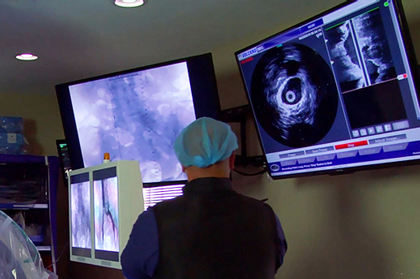
El uso del ultrasonido intravascular en la angioplastia de tronco no protegido se asocia con mejores resultados en comparación con la angioplastia guiada solo por angiografía.

Results can be credited to a refinement in technique, better drug-eluting stents, better patient selection, and frequent use of coronary intravascular ultrasound (IVUS) to guide and monitor the procedure.

IVUS has been strongly associated with the best results, both in randomized trials and in registries, and it currently holds a class IIa recommendation in guidelines. However, despite all of that, there is a wide variation in the use of IVUS, both in terms of region and operator opinion.

Many experienced operators may feel that, with an angiography, their eyes are just as good as an IVUS, but that is false and it goes against plenty of evidence. Other reasons behind such dispersion in use may be of economic nature. There are regions where this practice is not covered by health insurance, while it is covered in full in others. For example, in Japan, this practice is 100% covered, which easily explains why IVUS is used in over 85% of all angioplasty procedures conducted there.


Read also: Aortic Valvuloplasty as a Bridge to TAVR: Are We Wasting Our Time?


This study, recently published in JACC Cardiovascular Interventions, analyzed the trend in the use of IVUS and the outcomes of unprotected left main coronary artery angioplasty in England.

With over 11,000 patients included, this work represents the largest registry in the world accounting for the use of IVUS in this setting.

IVUS use increased from 30.2% in 2007 to 50.2% in 2014. After adjusting for multiple variables, the use of IVUS was associated with a reduction in major cardiovascular events at 30 days (46%) and one year (34%).


Read also: Tricuspid valve: Is Percutaneous Intervention Feasible in Patients with Definite Pacemaker?


If we analyze mortality alone, there is a 4% reduction at 30 days and a 10% reduction at 12 months, approximately.

This trend was consistent with an increase in the use of IVUS, which means that the influence of other variables (technique, drugs, etc.) on the outcomes is highly unlikely.

IVUS is definitely a necessity in left main coronary artery angioplasty, but it is also a luxury. In England, in the best of cases, only half the patients had an IVUS during their left main coronary artery angioplasty.

Original Title: Intravascular Imaging and 12-Month Mortality After Unprotected Left Main Stem PCI. An Analysis From the British Cardiovascular Intervention Society Database.

Reference: Tim Kinnaird et al. J Am Coll Cardiol Intv 2020;13:346–57.


Subscribe to our weekly newsletter

Get the latest scientific articles on interventional cardiology

 

More articles by this author

EuroPCR 2026 | 10-Year Left Main PCI: When Survival Is Similar, Should the Less Invasive Strategy Prevail?

The primary goal of revascularization in left main coronary artery disease (LMCA) is to improve survival. However, debate continues regarding whether, in anatomically suitable...

EuroPCR 2026 | TAVI and Coronary Artery Disease: FFR-Guided PCI Showed Better Outcomes Than an Angiography-Guided Strategy

In patients undergoing TAVI, the concomitant presence of coronary artery disease continues to generate debate: whether coronary lesions should be treated before, during, or...

EuroPCR 2026 | Evolocumab Reduces Cardiovascular Events in Patients With Prior PCI Without Previous Myocardial Infarction: VESALIUS-CV Results

This presentation, delivered by Dr. Brian A. Bergmark and colleagues at EuroPCR 2026, detailed the results of the VESALIUS-CV trial, focusing specifically on the...

EuroPCR 2026 | Is It Safe to Stop Aspirin After One Month in MI Patients Undergoing PCI? TARGET-FIRST Analysis

This is a summary of the post-hoc analysis of the TARGET-FIRST study, presented by Dr. Giuseppe Tarantini at EuroPCR 2026, evaluating early aspirin discontinuation...

LEAVE A REPLY

Please enter your comment!
Please enter your name here

Related Articles

SOLACI Sessionsspot_img
Jornadas Guatemala 2026

Recent Articles

EuroPCR 2026 | TAVI in Women: Do Supra-Annular Valves Offer a True Hemodynamic Advantage?

Women represent a particularly challenging population for TAVI, as they often have smaller aortic annuli, greater frailty, and an increased risk of prosthesis-patient mismatch....

EuroPCR 2026 | TAVI or Surgery in Younger Patients? Quality of Life and 3-Year Outcomes from NOTION-2

The expansion of TAVI into younger and lower surgical-risk populations has sparked a new debate: beyond mortality and stroke, which strategy provides better functional...

EuroPCR 2026 | MELA Registry: Myval Showed Lower Aortic Regurgitation Rates in Patients With Large Aortic Annuli

This presentation, delivered by Dr. Salvatore Giordano at EuroPCR 2026, detailed the results of the MELA Registry, a multicenter study comparing the performance of...

