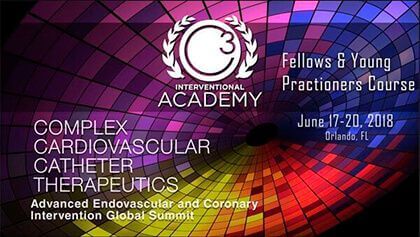
 From June 27th to June 30th, Orlando, Florida will hold the Complex Cardiovascular Catheter Therapeutics (C3 Conference), an event with a steadily growing number of attendees each year.
The Conference Organizing Committee grants, through SOLACI, five scholarships for professionals aiming to present their approved work or complex case.
Scholarships include the following:
- Congress registration fee.
- Three nights lodging for the aforementioned date.
- Plane tickets through the Congress official travel agency (with a maximum limit of USD 1000).
How can you submit your work?
Cases shall be submitted through the following form:
Your presentation must fulfill the following requirements:
-
- Submit a “.doc” or “.docx” file with the description of the case to be presented. The text must be up to 300 words long, in an 11 pt font.
-
- Submit a supplementary “.ppt” or “.pptx” file with the case presentation. While videos (up to 5) will be admitted for use during the oral presentation, this initial file can only include up to 5 fixed images.
-
- Case and description must be submitted in english.
-
- Presenters can submit more than one case. In such a circumstance, they shall make different submissions, one for each presentation.
Submission deadline: March 30th, 2018.
C3 is a Congress designed for physicians who specialize in interventional cardiology, vascular surgery, and interventional radiology, as well as fellows, residents, and other healthcare professionals interested in atherosclerotic cardiovascular disease. C3 offers presentations and debates with expert global faculty, live and pre-recorded cases, industry-sponsored and supported symposia, exhibit booths and simulators, poster sessions, case presentations and hands-on workshops.
Learn more www.c3conference.net
Get the latest scientific articles on interventional cardiologySubscribe to our weekly newsletter
We are interested in your opinion. Please, leave your comments, thoughts, questions, etc., below. They will be most welcome.