






Coronary bifurcations are one of the most challenging scenarios in percutaneous coronary intervention (PCI) due to their anatomical complexity, the risk of carina shift, and the higher incidence of long-term adverse events compared with non-bifurcation lesions.
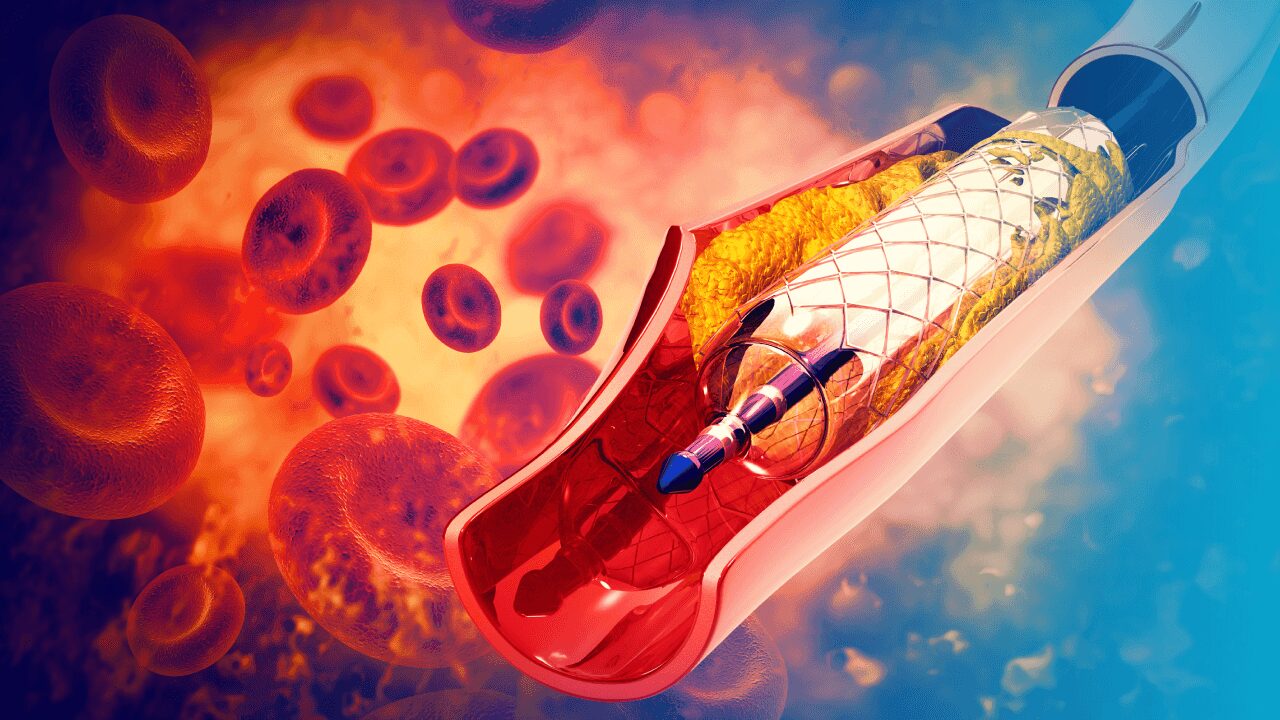
Provisional stenting in the main vessel remains the preferred strategy according to international consensus statements such as those from the European Bifurcation Club (EBC). However, the best way to optimize the management of side-branch involvement is still uncertain. In this context, the use of drug-coated balloons (DCB) has emerged as a physiological alternative: the hypothesis is that it will reduce restenosis and simplify the procedure.
A study by Corballis N. et al. compared the outcomes of a DCB-based strategy versus second-generation drug-eluting stents (DES) in de novo bifurcation lesions. Using a retrospective analysis with propensity-score matching, researchers evaluated the incidence of the composite endpoint recommended by Bif-ARC: cardiovascular death, target bifurcation myocardial infarction (TB-MI), and clinically indicated target bifurcation revascularization (TBR).
All patients treated for a bifurcation according to the EBC-ARC definition (side-branch ≥2 mm) were included in the study. The maximum follow-up reached five years, making this the dataset with the longest available clinical follow-up in this setting.
In total, 2052 matched cases were analyzed. The mean age was 68 years, 19% of patients were women, and all clinical presentations were represented, with 26% of patients with ST-segment elevation myocardial infarction (STEMI) in both groups. The median follow-up was 3.6 years, with data available up to 5 years in 48.8% of the cohort. The use of intravascular imaging was low (~3% between intravascular ultrasound [IVUS] and optical coherence tomography [OCT]).
In the matched analysis, the primary endpoint occurred less frequently in the DCB group than in the DES group (9.9% vs 14.0%; hazards ratio [HR] 1.39 for DES vs DCB; 95% confidence interval [CI] 1.08–1.79; p=0.01). This difference was mainly driven by a lower rate of TBR (5.0% vs 8.9%; HR 1.79; 95% CI 1.27–2.50; p<0.001) and a lower incidence of TB-MI (1.6% vs 3.0%; HR 1.92; 95% CI 1.05–3.57; p=0.03), with no significant differences in cardiovascular mortality (HR 0.94; 95% CI 0.65–1.37; p=0.75).
Conclusions
In this contemporary cohort with adequate follow-up and a low proportion of left-main disease (~5%), the retrospective comparison between strategies showed clinically meaningful results in favor of DCB, with lower target revascularization requirements and lower incidence of TB-MI up to five years.
Original Title: A Comparison of a Drug Coated Balloon With Drug Eluting Stent Strategy for Treating Coronary Bifurcation Lesions.
Reference: Corballis N, Merinopoulos I, Bhalraam U, Gunawardena T, Tsampasian V, Natarajan R, Wickramarachchi U, Mohamed M, Clark A, Mamas MA, Vassiliou VS, Eccleshall S; SPARTAN‐Norfolk Consortium. A Comparison of a Drug Coated Balloon With Drug Eluting Stent Strategy for Treating Coronary Bifurcation Lesions. Catheter Cardiovasc Interv. 2025 Oct 28. doi: 10.1002/ccd.70273. Epub ahead of print. PMID: 41147211.
Subscribe to our weekly newsletter
Get the latest scientific articles on interventional cardiology



, debido a su complejidad anatómica, el riesgo de desplazamiento de la carina y la mayor incidencia de eventos adversos a largo plazo en comparación con las lesiones no bifurcadas.)