Percutaneous coronary intervention (PCI) in complex lesions continues to represent a technical challenge in contemporary interventional cardiology. Angiography, although it remains the most widely used tool for decision-making, has well-known limitations, including the assessment of plaque burden, accurate determination of the severity of calcification, definition of lesion length and borders, and, most importantly, optimization of stent implantation.
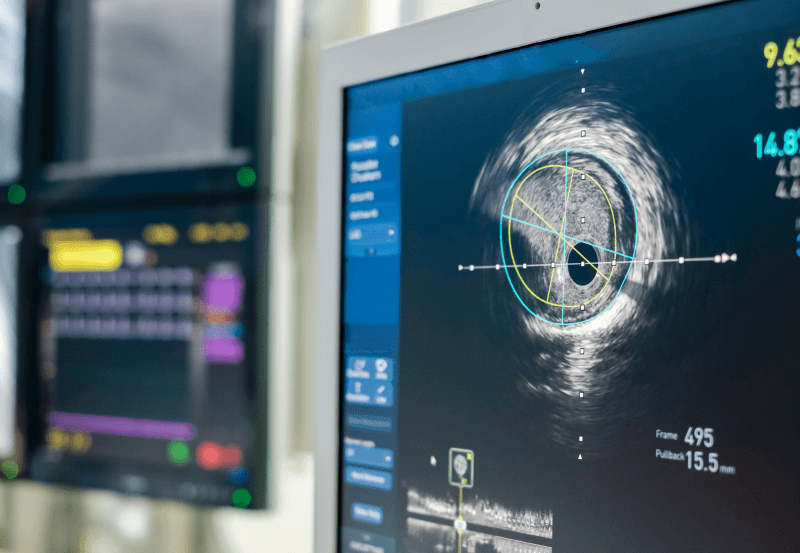
In this context, intravascular imaging (IVI—IVUS or OCT) has been shown to reduce the incidence of major adverse cardiovascular events (MACE) compared with angiography alone. However, the consistency of this benefit across different subgroups of complex lesions had not been systematically evaluated.
The aim of the study by Carvalho PEP et al. was to evaluate the impact of IVUS and OCT as guidance strategies for PCI with drug-eluting stents, compared with conventional angiography, in patients with complex coronary lesions. To this end, a lesion-level network meta-analysis was performed. Complex lesions included left main coronary artery disease, chronic total occlusions, true bifurcations, multivessel disease, ostial lesions, and moderately or severely calcified lesions. The primary endpoint was the incidence of MACE, defined as cardiac death, myocardial infarction, or target vessel revascularization.
Seventeen randomized studies were included, representing a total of 13,751 patients who underwent PCI. The use of IVUS was associated with a significant reduction in the relative risk of MACE (RR: 0.67; 95% CI: 0.56–0.79; p<0.001), while OCT showed a similar benefit (RR: 0.63; 95% CI: 0.55–0.72; p<0.001). No significant differences were observed between IVUS and OCT (RR: 0.94; 95% CI: 0.78–1.14; p=0.52).
Study results: IVUS and OCT reduce MACE compared with angiography in complex coronary lesions
The benefit of IVI-guided PCI was consistent across all analyzed subgroups. In left main coronary artery disease, both IVUS (RR: 0.52; 95% CI: 0.33–0.86; p=0.02) and OCT (RR: 0.51; 95% CI: 0.30–0.86; p=0.01) significantly reduced events. In chronic total occlusions, IVUS was associated with a significant reduction in MACE (RR: 0.57; 95% CI: 0.37–0.88; p=0.01). In bifurcations, moderately or severely calcified lesions, long lesions, and multivessel disease, both imaging techniques were associated with a significant reduction in events compared with coronary angiography, without relevant differences between IVUS and OCT (with respective RRs of 0.83, 0.92, 0.81, and 1.27).
Sensitivity analyses confirmed these findings, showing a significant reduction in MACE for both IVUS (HR: 0.47; 95% CI: 0.36–0.61) and OCT (HR: 0.56; 95% CI: 0.40–0.80). In addition, the strategy ranking analysis using the P score consistently positioned angiography as the least favorable option, while IVUS and OCT alternated first place depending on lesion subtype. IVUS ranked higher in bifurcations and long lesions, whereas OCT ranked higher in multivessel disease.
Original Title: IVUS, OCT, or Angiography as Guidance for PCI in Complex Coronary Artery Lesions. Network Meta-Analysis of Randomized Controlled Trials.
Reference: Carvalho PEP, Antunes VLJ, Bittar de Pontes V, Gomes WF, Polachini Assunes Goncalves B, Caixeta A, Strepkos D, Alexandrou M, Mutlu D, Gibson CM, Stone GW, Bhatt DL, Windecker S, Patel MR, Angiolillo D, Mehran R, Valgimigli M, Costa MA, Sandoval Y, Brilakis ES, Lopes RD, Nascimento BR. IVUS, OCT, or Angiography as Guidance for PCI in Complex Coronary Artery Lesions: Network Meta-Analysis of Randomized Controlled Trials. JACC Cardiovasc Interv. 2026 Jan 12;19(1):31-43. doi: 10.1016/j.jcin.2025.11.021. PMID: 41534986.
Subscribe to our weekly newsletter
Get the latest scientific articles on interventional cardiology