






Courtesy of Dr. Carlos Fava.
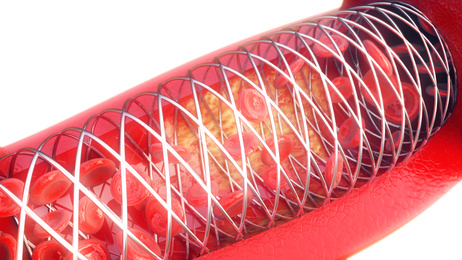 Nowadays, chronic total occlusions (CTO) due to in-stent restenosis (ISR) represent 5%-25% of all coronary angioplasties. These lesions pose a new and true challenge, since CTOs are often associated with stent-related problems (fractures, lack of expansion, overlapping, deformation), extreme tortuosity, severe calcification, tandem lesions after CTO, and aorto-ostial lesions, with little evidence on outcomes and evolution.
This study included 233 patients with CTO due to ISR. There was procedural success in 192 cases (82.4%).
Populations were similar: the mean age was 62 years old (most patients were male), 40% of all patients had diabetes, 6% had undergone previous myocardial revascularization surgery (MRS), 10% presented peripheral vascular disease, and 5% had previously experienced a stroke. As regards CTO, 34% of patients experienced it in the left anterior descending artery, 47% in the right coronary artery, and 18% in the left circumflex artery. Lesion length was 28 mm; 16% of patients presented severe calcification, 22% presented moderate-severe tortuosity, 37% experienced bridging collaterals, 44% had a J-CTO score >3, and in 13% of cases CTO had ostial location.
The rechanneling failure rate was higher for CTOs with a J-CTO score >3, those in the left circumflex artery, and in ostial lesions.
Transfemoral access was more frequent in the successful group (92% vs. 80%; p = 00.03), with a trend for higher usage of 8-Fr catheters. The antegrade approach was the one most used (94%). Complications during the procedure occurred in 9.7% of all cases (coronary dissection in 5.2% of all patients and coronary perforation without tamponade in 4.5% of them).
The length of follow-up was 20 months. There was no difference regarding major adverse cardiac events (MACE) (19%), but the group of patients with failed procedures presented higher rates of cardiac death (8.3% vs. 3%), all-cause death (11.4% vs. 4.7%; p = 0.09), and the need for MRS (13.7% vs. 1.7%). In the successful rechanneling group, the rate of target-lesion revascularization was 15%, the rate of reocclusion was 6%, and the rate of definite/probable thrombosis was 1.8%.
Conclusion
Percutaneous treatment of CTO due to ISR in contemporary practice shows a high success rate with good long-term results. Identified angiographic and procedural predictors may contribute to improve procedural outcomes through better patient selection.
Editorial Comment
This is one of the few studies analyzing only CTOs due to ISR. In the future, the number of these cases will surely increase till they constitute a subgroup requiring a management strategy different from that for traditional CTOs.
The most important aspect of this analysis is that successful angioplasty for a CTO due to ISR showed significant improvement of the cardiac death rate. This may possibly be due to the fact that the study treated patients with prior interventions, as opposed to what happens with pure CTOs.
Furthermore, the success rate increased over time (surely due to the learning curve), without using drug-eluting stents in all patients. In any case, outcomes during follow-up were still good.
One of the present limitations is that transfemoral access is still used along with a high rate of use of 8-Fr catheters. In the future, this procedure may possibly be carried out through a transradial access with dedicated radial introducers (Glidesheath Slender or similar) and lower-gauge diameter.
Courtesy of Dr. Carlos Fava.
Original title: Percutaneous Intervention in Chronic Total Coronary Occlusions Caused by In-Stent Restenosis: Procedural Results and Long-Term Clinical Outcomes in the TORO (Spanish registry of chronic Total occlusion secondary to an occlusive in-stent RestenOsis) Multicentre Registry.
Reference: Jose M. de la Torre Hernandez, et al. EuroIntervention 2017;13:e219-226
Get the latest scientific articles on interventional cardiologySubscribe to our weekly newsletter
We are interested in your opinion. Please, leave your comments, thoughts, questions, etc., below. They will be most welcome.



