






Abdominal aortic aneurysms (AAA) are those of >3 cm aortic diameter. They run the risk of rupture and ensuing death by bleeding. In consequence, they are treated to repair the aneurysm before it ruptures.
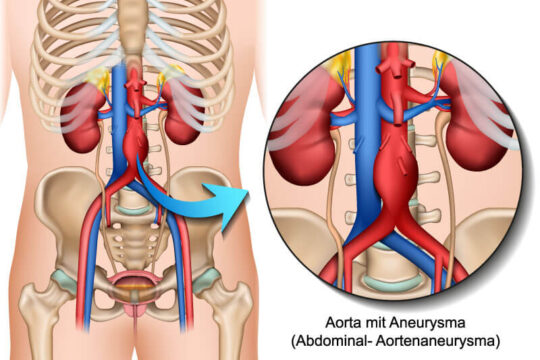
In this regard, the most relevant predictor of rupture is aneurysm diameter. That is, the greater the aneurysm, the greater the risk.
Randomized studies have not shown advantages in survival when <5.5 cm aneurysms were surgically treated vs. close observation. This evidence supports the use of 5.5 cm diameter as a cutoff value. Therefore, watching <5.5 cm aneurysms closely is safe and cost effective.
Close observation, among other things, will detect aneurysms that might present accelerated sac growth (>1 cm in one year), even though we lack rigorous information to support intervention in this context.
The key clinical points for AAA management in 2021 are:
- Risk factors include advanced age, male sex, family history, smoking, hypercholesterolemia, and hypertension. Diabetics run the lowest risk.
- In men, AAA should be repaired when they are ≥5.5 cm diameter, and in women, when they are ≥5 cm.
- Endovascular repair of AAA is associated with lower risk of perioperative complications and death vs. open surgery.
- The initial advantage of endovascular repair is kept for 2 or 3 years after procedure. There are no differences at long term in terms of death.
- Endovascular repair is associated to more reinterventions, in general simple procedures. Throughout patient life, open surgery is associated to more reinterventions due to laparotomy.
- For close observation, both CT and echocardiography are adequate.
Read also: TCT 2021 | STOPDAPT-2 and MASTER-DAPT: The Conversation Continues from ESC to TCT.
This is the most succinct information, and it is not much different from what have known for some time. Data are reassuring, seeing as they indicate we understand this disease, and thus we can take preventive action.
Original Title: Management of Abdominal Aortic Aneurysms.
Reference: Andres Schanzer et al. N Engl J Med 2021;385:1690-8. DOI: 10.1056/NEJMcp2108504.
Subscribe to our weekly newsletter
Get the latest scientific articles on interventional cardiology



