



Management of Abdominal Aortic Aneurysms in 2021

Abdominal aortic aneurysms (AAA) are those of >3 cm aortic diameter.  They run the risk of rupture and ensuing death by bleeding. In consequence, they are treated to repair the aneurysm before it ruptures. 
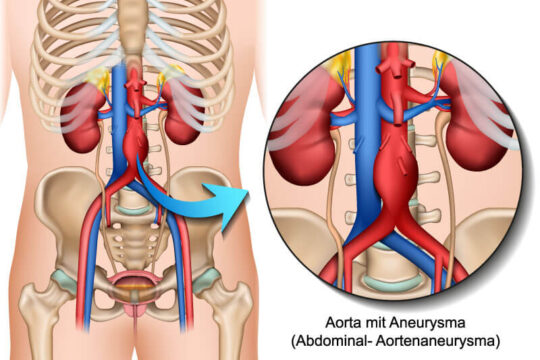
Manejo de los aneurismas de aorta abdominal en 2021

In this regard, the most relevant predictor of rupture is aneurysm diameter. That is, the greater the aneurysm, the greater the risk. 

Randomized studies have not shown advantages in survival when <5.5 cm aneurysms were surgically treated vs. close observation. This evidence supports the use of 5.5 cm diameter as a cutoff value. Therefore, watching <5.5 cm aneurysms closely is safe and cost effective. 

Close observation, among other things, will detect aneurysms that might present accelerated sac growth (>1 cm in one year), even though we lack rigorous information to support intervention in this context. 

The key clinical points for AAA management in 2021 are:

  • Risk factors include advanced age, male sex, family history, smoking, hypercholesterolemia, and hypertension. Diabetics run the lowest risk. 
  • In men, AAA should be repaired when they are ≥5.5 cm diameter, and in women, when they are ≥5 cm.
  • Endovascular repair of AAA is associated with lower risk of perioperative complications and death vs. open surgery. 
  • The initial advantage of endovascular repair is kept for 2 or 3 years after procedure. There are no differences at long term in terms of death. 
  • Endovascular repair is associated to more reinterventions, in general simple procedures. Throughout patient life, open surgery is associated to more reinterventions due to laparotomy. 
  • For close observation, both CT and echocardiography are adequate.

Read also: TCT 2021 | STOPDAPT-2 and MASTER-DAPT: The Conversation Continues from ESC to TCT.


This is the most succinct information, and it is not much different from what have known for some time. Data are reassuring, seeing as they indicate we understand this disease, and thus we can take preventive action. 

nejmcp2108504

Original Title: Management of Abdominal Aortic Aneurysms.

Reference: Andres Schanzer et al. N Engl J Med 2021;385:1690-8. DOI: 10.1056/NEJMcp2108504.


Subscribe to our weekly newsletter

Get the latest scientific articles on interventional cardiology

More articles by this author

Is upper-limb aerobic training an effective alternative to lower-limb exercise in peripheral artery disease?

Peripheral artery disease is associated with impaired functional capacity, reduced walking distance, and poorer quality of life, and structured exercise is a class I...

Endoleaks after endovascular repair of complex aortic aneurysms: always reintervene or monitor with CTA?

Endovascular repair of thoracoabdominal aneurysms requiring sealing above the renal arteries, with preservation of visceral vessels using fenestrated and/or branched devices (F/B-EVAR), has become...

A New Asymptomatic Carotid Stenosis Paradigm? CREST-2 Trial Unified Results

Severe asymptomatic carotid stenosis continues to be controversial seeing the optimization of intensive medical therapy (IMT) and the availability lower periprocedural risk revascularization techniques....

Impact of Baseline Systolic Blood Pressure on Blood Pressure Changes Following Renal Denervation

Renal denervation (RDN) is a guideline-recommended therapy to reduce blood pressure in patients with uncontrolled hypertension, although uncertainties remain regarding which factors best predict...

LEAVE A REPLY

Please enter your comment!
Please enter your name here

Related Articles

SOLACI Sessionsspot_img

Recent Articles

Comparison of strategies: NMA of IVUS, OCT, or angiography in complex lesions

Percutaneous coronary intervention (PCI) in complex lesions continues to represent a technical challenge in contemporary interventional cardiology. Angiography, although it remains the most widely...

Is upper-limb aerobic training an effective alternative to lower-limb exercise in peripheral artery disease?

Peripheral artery disease is associated with impaired functional capacity, reduced walking distance, and poorer quality of life, and structured exercise is a class I...

Dynamic Coronary Roadmap: does it really help reduce contrast use?

Contrast-induced nephropathy remains a relevant complication of percutaneous coronary interventions (PCI), particularly in patients with multiple comorbidities and complex coronary anatomies. Dynamic Coronary Roadmap...

