



ESC 2022 | TIME STUDY

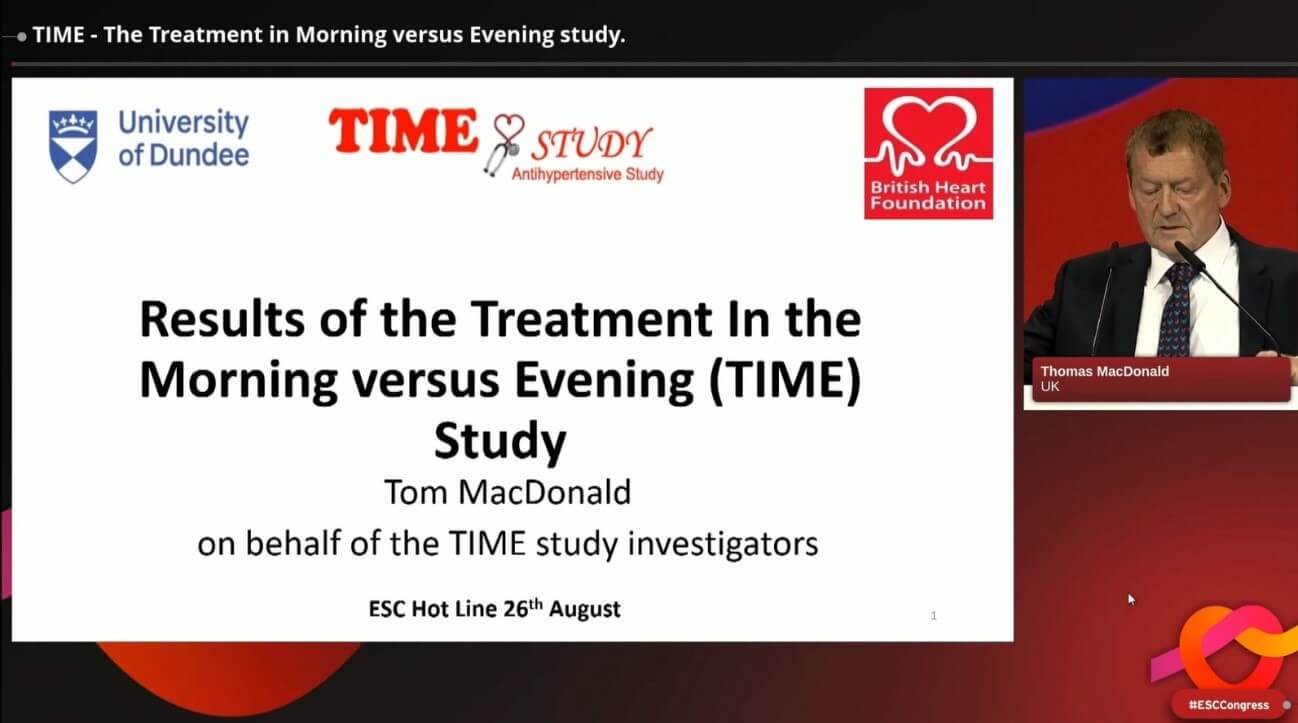
The TIME study, presented by Dr. Thomas MacDonald, is a randomized study of over 21,000 patients with high blood pressure with a follow-up beyond 5 years.
ESC 2022

As is widely known, high blood pressure is the leading global cause of early death, accounting for nearly 10 million deaths in 2015, of which 4.9 million were caused by ischemic heart disease and 3.5 million, by stroke. Nocturnal blood pressure is a better predictor of cardiovascular events than diurnal blood pressure. According to the results of the Hygia study, administering medication at night could be a protective factor for cardiovascular events.

Based on these data, researchers developed prospective, randomized study TIME. Its objective was to show whether administering antihypertensive medication during the afternoon could improve the rates of cardiovascular events compared with morning medication.

Patients taking at least one antihypertensive drug were randomized 1:1 to drug administration in the morning or in the evening. The primary endpoint (PEP) was a composite of hospitalization for nonfatal acute myocardial infarction, nonfatal stroke, or vascular death.

Leia também: TAVI em bicúspides: os resultados são os mesmos em homens e mulheres?

The study included 21,104 patients with a mean age of 65 years; 58% of them were men, and the mean follow-up was 5.2 years. The PEP was observed in 3.4% of those who took the medication in the morning vs. 3.7% of those who took it in the afternoon (hazard ratio: 0.95; 95% confidence interval: 0.83-1.10; p = 0.53). These results did not vary between the different subgroups analyzed.

Conclusion

This study, with a very large cohort of patients, showed no changes in the occurrence of acute myocardial infarction, stroke, or vascular death based on the administration of antihypertensive treatments at different times of the day.
TIME STUDY ESC 2022
Dr. Omar Tupayachi

Dr. Omar Tupayachi.
Membro do Conselho Editorial da SOLACI.org.

Fonte: MacDonald TM. TIME – the Treatment in Morning versus Evening study. Presentado en el Congreso Europeo de Cardiología ESC 2022. Agosto 26, 2022. Barcelona, España.


Subscreva-se a nossa newsletter semanal

Receba resumos com os últimos artigos científicos

Previous article
Next article

More articles by this author

CRT 2026 | Clopidogrel vs Aspirin as Long-Term Monotherapy After Coronary Angioplasty

The use of aspirin as chronic antiplatelet therapy after percutaneous coronary intervention (PCI) has historically been the standard recommended by international guidelines. However, recent...

Low-Dose Rivaroxaban After Peripheral Angioplasty: Effectiveness and Safety in Real-World Clinical Practice

Following lower limb revascularization, optimal medical therapy includes antiplatelet agents, high-intensity statins, and control of cardiovascular risk factors. Recent studies such as COMPASS and...

How real are the adverse effects of statins? Evidence from randomized clinical trials

The safety of statins continues to be a subject of debate, partly due to the extensive list of adverse effects included in prescribing information,...

Is it safe to use negative chronotropic drugs early after TAVI?

TAVI is associated with a relevant incidence of conduction system disturbances and the development of atrioventricular block that may require permanent pacemaker implantation. Many...

LEAVE A REPLY

Please enter your comment!
Please enter your name here

Related Articles

SOLACI Sessionsspot_img

Recent Articles

CRT 2026 | TAVI-CLOSE Trial: Dual Suture vs Suture + Plug for Vascular Closure After Transfemoral TAVI

The transfemoral approach is the predominant strategy for transcatheter aortic valve implantation (TAVI). Although vascular complications are currently less frequent, they remain relevant determinants...

CRT 2026 | NAVITOR IDE: Hemodynamic Outcomes and 5-Year Durability of an Intra-Annular Self-Expanding Transcatheter Aortic Valve

As TAVI expands into younger populations and patients with lower surgical risk, prosthesis durability has become a key aspect of long-term management. The NAVITOR...

CRT 2026 | CUT-DRESS Trial: Lesion Preparation with Cutting Balloon

In-stent restenosis (ISR) continues to represent a relevant clinical challenge in contemporary coronary angioplasty practice. Despite advances in drug-eluting stents, neointimal hyperplasia and suboptimal...

