



Minimal Stent Area: New IVUS Parameter?

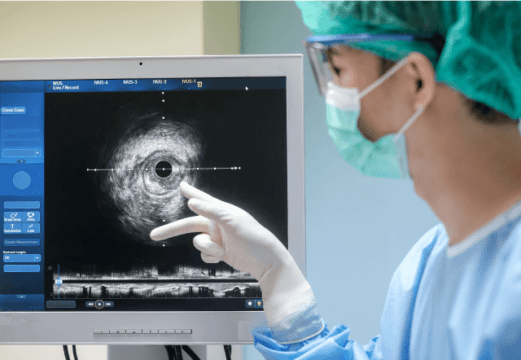
Intravascular Ultrasound (IVUS) has shown, in several studies, its great benefits for both restenosis and mortality reduction.  
Área mínima del stent ¿es un nuevo parámetro para tener en cuenta en el IVUS?

Even though several variables have been studied, so far minimal stent area (MSA) has been disregarded as important. 

The OPTIVUS-Complex PCI looked at 961 patients with 1,957 lesions, and found 1.6% TLR incidence (30 lesions).

There were no significant differences between patients presenting TLR and those who did, except for a higher incidence of hemodialysis in the second group. 

As regards the procedure, there were no differences in pre and post dilation, lesion complexity, chronic occlusions, vessel diameter, QCA, lesion length, or proximal reference area. 

Time from PCI to TLR was 251 days (167-325), and 73% happened after 180 days. 

Read also: Association Between Radial Wall Strain (RWS) and Risk of Acute Myocardial Infarction.

66.7% of TLR was ischemia driven. 

Even though hemodialysis and MSA were more frequent in TLR patients, the difference did not reach statistical significance. 

Conclusion

At present, TLR incidence after IVUS guided PCI at one year is quite low. Minimal stent area, but not other stent expansion criteria, has been associated with TLR upon multivariable analysis. Independent factors were calcified lesions and small proximal reference lumen area. Therefore, these findings should be interpreted with caution, seeing the low number of TLR events, the limited number of complex lesions and the short followup. 

Dr. Carlos Fava - Consejo Editorial SOLACI

Dr. Carlos Fava.
Member of the Editorial Board of SOLACI.org.

Original Title: Target Lesion Revascularization After Intravascular Ultrasound-Guided Percutaneous Coronary Intervention.

Reference: Yamamoto, et al. Circ Cardiovasc Interv.2023;16:e012922.DOI:10.1161/CIRCINTERVENTIONS.123.012922.


Subscribe to our weekly newsletter

Get the latest scientific articles on interventional cardiology

More articles by this author

Coronary Perforations and Use of Covered Stents: Safe and Effective Long-Term Strategy?

Coronary perforations remain one of the most serious complications of percutaneous coronary intervention (PCI), especially in cases of Ellis ruptures type III. In these...

Left Main Coronary Artery Disease: Intravascular Imaging-Guided PCI vs. Coronary Artery Bypass Grafting

Multiple randomized clinical trials have demonstrated superior outcomes with coronary artery bypass grafting (CABG) vs. percutaneous coronary intervention (PCI) in patients with left main...

AHA 2025 | OCEAN Study: Anticoagulation vs. Antiplatelet Therapy After Successful Atrial Fibrillation Ablation

After a successful atrial fibrillation (AF) ablation, the need to maintain long-term anticoagulation (AC) remains uncertain, especially considering the very low residual embolic risk...

AHA 2025 | VESALIUS-CV: Evolocumab in High-Cardiovascular-Risk Patients Without Prior MI or Stroke

LDL cholesterol is a well-established factor for cardiovascular disease. Therapy with PCSK9 inhibitors, including evolocumab, has been shown to reduce the risk of cardiovascular...

LEAVE A REPLY

Please enter your comment!
Please enter your name here

Related Articles

SOLACI Sessionsspot_img

Recent Articles

Coronary Perforations and Use of Covered Stents: Safe and Effective Long-Term Strategy?

Coronary perforations remain one of the most serious complications of percutaneous coronary intervention (PCI), especially in cases of Ellis ruptures type III. In these...

Is it really necessary to monitor all patients after TAVR?

Conduction disorders (CD) after transcatheter aortic valve replacement (TAVR) are a frequent complication and may lead to the need for permanent pacemaker implantation (PPI)....

Is it really necessary to monitor all patients after TAVR?

Conduction disorders (CD) after transcatheter aortic valve replacement (TAVR) are a frequent complication and may lead to the need for permanent pacemaker implantation (PPI)....

