






5-year followup of bioresorbable scaffolds in selected and better prepared lesions (ABSORB IV).
Historically, when comparing previously used therapies, such as conventional balloon angioplasty (BA) against bare metal stent (BMS) and later against drug eluting stent (DES) implantation, we see significantly improved outcomes. These advances have shown reduced recoil and more effective restenosis inhibition, compared against their predecessors.
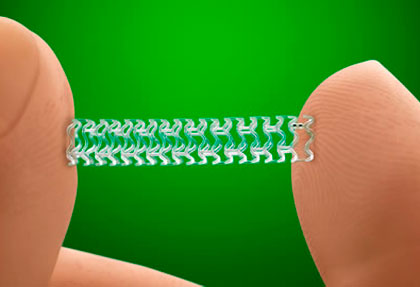
However, DES stenting could have hemodynamic consequences at long term, altering flow pulsatile and arterial motion (the so called vasomotor effect, given the caging with struts), creating certain rigidity, and potentially nesting neointimal proliferation and neoatherosclerosis.
A potential alternative able to provide early mechanical support and capable of complete reabsorption over the years, looked tempting. That is what bioresorbable vascular scaffolds (BVS) offer, since they prevent side branch caging or the possibility of reabsorption in very long segments (jacket), generating suitable ground for future bypass.
Aiming at assessing BVS performance (Absorb BVS) compared against DES (Xience CoCr-EES), the ABSORB IV was carried out (5-year followup). This is the largest randomized study on this topic, with 2604 patients (US, Canada, Germany, Australia and Singapore). Study population was better selected (de novo lesions) compared to its predecessors (ABSORB I, II and III), including ≤24mm lesions with reference diameter between 2.25mm and 3.75mm, mandatory predilation and post dilation with noncompliant high pressure balloons (strongly recommended) and the inclusion of patients with acute and stable coronary syndrome.
Read also: No Reflow after Primary PCI in STEMI: An Angiographic Analysis of the TOTAL Study.
Primary end point was target lesion failure, the outcome comprised of cardiac death, target vessel MI or ischemia driven revascularization at 30 days. Secondary end points were TLF or angina at one year. Other events included target vessel failure (TVF), major adverse cardiovascular events (MACE) and patient centered outcomes.
1296 patients received the Absorb BVS and 1308 the Xience CoCr-EES. Mean age was 63.1, 72% were men, 31.6% diabetic and the most common clinical presentation was ACS in 41.6% of cases. There was a low percentage of treatment to calcified lesions (24.1%), bifurcation (17%) or marked tortuosity (17.3%), with mean length 14.8±6.2mm. Post procedure, there was less lumen gain and residual stenosis with BVS (intravascular imaging in 15.6% of cases).
When looking at outcomes, there was TLF at 5 years in 17.5% of BVS patients vs 14.5% of DES patients (HR 1.24, CI 95% 1.02-1.52; P=0.03) at the expense of target vessel MI and ischemia driven revascularization.
There were no significant differences in cardiac or all-cause mortality or in secondary outcomes such as TVF, MACE or patient centered outcomes. Landmark and pre-specified analysis showed non-significant increase in thrombosis in the first 3 years.
At 5 years, there was angina or angina equivalent in 53% of patients, with no differences vs. DES patients (53.3%).
Conclusions
There had been previous reports of non-inferiority in TLF primary end point at 30 days. However, this 5-year followup report saw BVS patients presented 3% TLF absolute increase, with higher risk in the first 3 years. Also, we should point out that there is a high percentage of patients reporting angina, over 50% in both branches. However, this symptom did not translate into repeat revascularization (only 15% of ischemia driven revascularization), but shows affected vasomotor and microcirculation, which should always be taken into account when deciding the therapeutic course of action.
Dr. Omar Tupayachi.
Member of the Editorial Board of SOLACI.org.
Original Title: 5-Year Outcomes After Bioresorbable Coronary Scaffolds Implanted With Improved Technique.
Reference: Stone, Gregg W et al. “5-Year Outcomes After Bioresorbable Coronary Scaffolds Implanted With Improved Technique.” Journal of the American College of Cardiology vol. 82,3 (2023): 183-195. doi:10.1016/j.jacc.2023.05.003.
Subscribe to our weekly newsletter
Get the latest scientific articles on interventional cardiology



