






At present, most percutaneous coronary intervention procedures (PCI) are done with drug eluting stents (DES). However, drug coated balloons (DCB) have shown benefits in restenosis and small vessel de novo lesions.
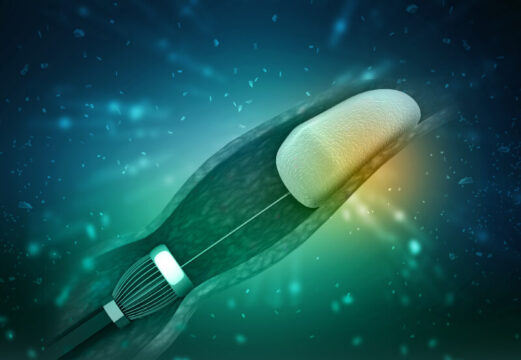
Intravascular ultrasound (IVUS) has been shown effective in left main PCI and complex procedures, even though there is little infomration on its use for PCIs with DCB.
The ULTIMATE III is a clinical randomized controlled open study comparing IVUS guided against angiography guided PCI in patients at high risk of bleeding.
The study included 260 patients with ≤15 mm, 2 to 4 mm in diameter lesions.
Primary end point was late lumen loss (LLL) at 7 months. Patient groups were similar as to demographic and clinical characteristics: mean age 67, 80% were men, 72% were hypertensive, 30% diabetic, 9% had a history of MI, 17% prior PCI, 9% ictus, 5% peptic ulcer, 12% atrial fibrillation, 45% anemia, 10% <100,000 platelet count and 14% kidney function deterioration.
Read also: Patients with CABG History and new N-ST ACS: Routine Invasive Strategy?
The most frequent clinical presentation was unstable angina (73%), followed by stable chronic angina (14%), and less frequently ST elevation acute myocardial infarction (STEMI), non-ST elevation acute MI (NSTEMI), and silent ischemia.
There were no differences in lesion localization, the anterior descending being the most affected, followed by the circumflex. Neither were there significant differences in procedure.
Primary end point resulted favorable for patients receiving IVUS guided PCI (0.03±0.52 mm for ANGIO PCI vs. 0.10±0.34 mm for IVUS PCI; mean difference 0.14 mm; CI 95%: 0.02-0.26; P = 0.025). Also, IVUS PCI was associated with less stenosis (28.15%±13.88% vs. 35.83%±17.69%; P = 0.001) and larger intraluminal diameter (2.06±0.62 mm vs. 1.75±0.63 mm; P < 0.001).
Conclusion
This study has shown IVUS guided PCI is associated with less late lumen loss in patients with de novo coronary lesions vs. angiography guided PCI.

Dr. Carlos Fava.
Member of the Editorial Board of SOLACI.org.
Original Title: Intravascular Ultrasound vs Angiography- Guided Drug-Coated Balloon Angioplasty.
Reference: The ULTIMATE III Trial. Xiao-Fei Gao, et al. J Am Coll Cardiol Intv 2024. Article in Press.
Subscribe to our weekly newsletter
Get the latest scientific articles on interventional cardiology



