






Treating severely calcified left main coronary artery (LMCA) lesions is one of the greatest challenges in interventional cardiology. Adequate pre-stenting lesion preparation is paramount for clinical outcome optimization and stent underexpansion reduction, associated to adverse events such as in stent thrombosis or restenosis.
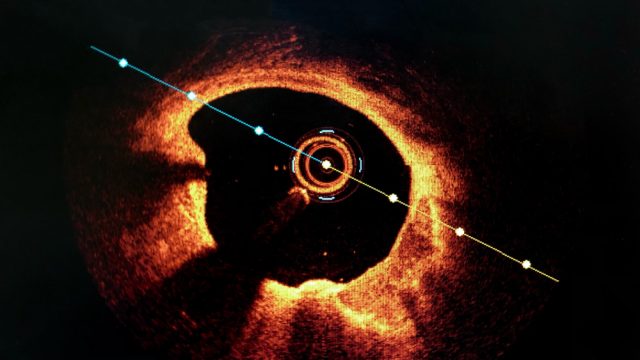
In this context, plaque modifying devices (PMDs) such as rotational atherectomy (RA), intravascular lithotripsy (IVL) and excimer laser coronary atherectomy (ELCA), have been developed, and become essential to treat these complex lesions.
Farag et al. have recently published in the Journal of Interventional Cardiology a retrospective analysis looking at clinical outcomes from 302 patients with severely calcified left main stenosis treated with one of these three plaque modifying devices, at a high volume UK center. Most cases were treated with RA (79%), while the use of IVL and ELCA was lower (10% and 11%, respectively).
85.8% of RA and IVL procedures were done on unprotected left main arteries, with high clinical and anatomical complexity (mostly using provisional stenting). Over half of patients (55%) were admitted with acute coronary syndrome (ACS). Despite these high risk profile, technical success rate resulted remarkably high (98.7%), with a procedural success rate of 95.4%.
Read also: Balloon-Expandable Myval Valve Four-Year Outcomes.
The analysis of hard end points such as long term mortality (42-month mean followup), reported a 19.9% global mortality rate, with no statistically significant differences between the groups (RA: 23.4%; IVL: 3.3%; ELCA: 15.6%; p=0.128). This suggests device type might not be the main determining prognostic factor at long term.
Multivariable analysis identified chronic kidney failure, a history of cardiac failure, low hemoglobin levels, elevated non -HDL cholesterol and using the transfemoral approach as independent mortality predictors.
Read also: Conduction Disorders Before TAVR: What Is Their Impact?
As regards safety outcomes, procedural complications were significantly more frequent among ELCA patients (21.9% vs. 2.5% with RA; p=0.018), which was attributed to greater baseline complexity of cases treated with this technique (habitually as a bailout strategy, when unable to use RA or IVL). We should note that this higher complications rate did not translate into worse clinical evolution during hospitalization.
Conclusions
This study by Farag et al. supports the safety and efficacy of plaque modifying devices in the treatment of severely calcified left main lesions. Intravascular imaging guidance, with individualized device selection according to anatomy and operator experience led to high technical success, low in-hospital events incidence and over 80% overall survival.
Original Title: Clinical Outcomes Following Atherectomy of Calcified Left Main Coronary.
Reference: Farag, Mohamed, Gungoren, Fatih, Al-Atta, Ayman, Abdalazeem, Ibrahem, Bawamia, Bilal, Alkhalil, Mohammad, Egred, Mohaned, Clinical Outcomes Following Atherectomy of Calcified Left Main Coronary, Journal of Interventional Cardiology, 2025, 9605550, 9 pages, 2025. https://doi.org/10.1155/joic/9605550.
Subscribe to our weekly newsletter
Get the latest scientific articles on interventional cardiology



 representa uno de los mayores desafíos en la cardiología intervencionista.)