






As part of the SOLACI-SOCIME 2025 Congress, the largest interventional cardiology event in Latin America, the Latin American Women Interventionalists Group MIL-SOLACI organized a prominent scientific session titled “Decoding ANOCA and INOCA: Mechanisms, Prognosis, and Patient-Centered Perspectives.”
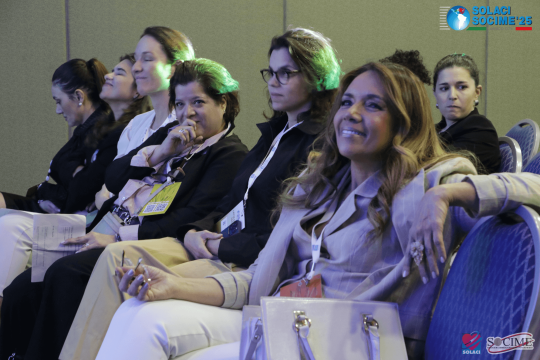
This session, led by coordinator Emma Miranda (Mexico), brought together experts in the field of cardiology to analyze the complexities of angina with no obstructive coronary arteries (ANOCA) and microvascular angina (INOCA), conditions that present a significant challenge in clinical practice.
The panel, composed of Gabriela Zeballos (Argentina), Anahí Florencio (Argentina), and Lisbeth Méndez (Venezuela), began with a presentation by Maria Sanali Paiva (Brazil), Director of the MIL Group, who discussed Endotypes of Angina with Non-Obstructive Coronary Arteries. Her presentation focused on the various pathological profiles that can trigger angina in patients without evident coronary obstructions, providing a more accurate understanding of these complex conditions.
Next, Patricia Aubanel (Mexico) addressed the topic Prognostic Stratification Strategies in Ischemia with Non-Obstructive Coronary Artery Endotypes, explaining how to identify risks and properly manage patients with these conditions.
Patricia Martin (Mexico) delivered the talk Microvascular Assessment in PCI: From Metabolic Profiles to Patient-Reported Outcomes, in which she discussed the importance of evaluating coronary microcirculation in patients undergoing percutaneous coronary intervention (PCI), linking metabolic data with patient-reported results.
The session concluded with a presentation by Belinda Díaz (Mexico), who shared a clinical case titled When Angina Persists: A Case of INOCA with Preserved Coronary Anatomy. In her talk, Díaz explained the clinical challenges faced by patients who, despite showing no coronary obstructions, continue to experience angina symptoms—highlighting the crucial need for thorough evaluation and personalized treatment approaches.
This session once again demonstrated the commitment of the Latin American Women Interventionalists Group MIL-SOLACI to continuing medical education and advancing the treatment of complex conditions, while also underscoring the high academic quality of the SOLACI-SOCIME 2025 Congress.
Subscribe to our weekly newsletter
Get the latest scientific articles on interventional cardiology



