






Free online course in Spanish
5 webinars in 2026
COMPLICAT 2026 returns with its second edition, consolidating itself as an innovative academic space dedicated to the analysis of real cases and complications in congenital and structural heart disease interventions.

Following the success of its first edition, the course expands its scope with an international scientific committee composed of specialists from Spain, Portugal, and Latin America, and is supported by the Sociedad Española de Cardiología Pediátrica y Cardiopatías Congénitas and the Sociedad Latinoamericana de Cardiología Intervencionista (SOLACI).
The central objective of COMPLICAT is to create a collaborative learning environment, where everyday clinical experience becomes a powerful educational tool to improve decision-making in complex scenarios.
A course focused on real clinical experience
The program is organized into dynamic thematic blocks, each consisting of high-level scientific presentations and interactive discussions of selected clinical cases.
This approach aims not only to provide up-to-date knowledge, but also to foster the exchange of experiences among specialists facing similar challenges in their daily clinical practice.
The main objectives of the course include:
-
Sharing real clinical experiences in the management of congenital and structural heart disease.
-
Strengthening international collaboration between teams from Europe and Latin America.
-
Creating new opportunities for academic and scientific cooperation among participants.
Beyond its scientific content, COMPLICAT stands out for its participatory and engaging format, where attendees can submit cases, participate in voting sessions, ask questions, and discuss therapeutic strategies with international experts.
Course format
COMPLICAT 2026 will be conducted entirely online and in Spanish, throughout the year 2026.
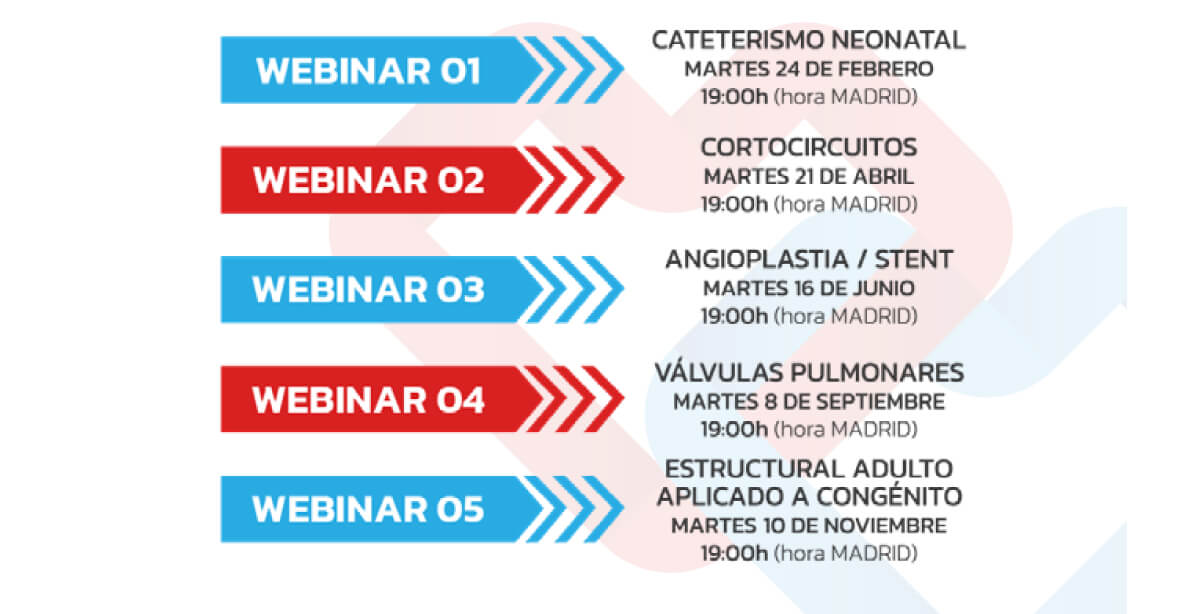
The course will be structured into five thematic blocks, each delivered through an interactive webinar, enabling active audience participation and in-depth analysis of complex clinical cases.
Educational objectives
The main objective of the course is to provide healthcare professionals with comprehensive and up-to-date training in hemodynamics applied to congenital heart disease, focusing on complication management and optimization of clinical decision-making.
Specific objectives include:
-
Acquiring advanced knowledge in neonatal catheterization, including indications, techniques, and complication management in newborns with critical congenital heart disease.
-
Deepening understanding of the diagnosis and treatment of intracardiac and extracardiac shunts.
-
Developing skills in angioplasty and stent implantation.
-
Updating clinical practice in percutaneous valve implantation.
-
Analyzing structural cases in adults with complex congenital heart disease.
-
Strengthening clinical reasoning in highly complex scenarios.
Subscribe to our weekly newsletter
Get the latest scientific articles on interventional cardiology



