






The contest ended. The authors of the selected cases for live presentation have been contacted by email
Call for Case Submission
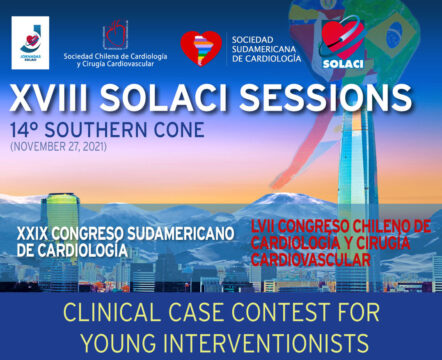
XLIII SOLACI Regional Sessions – 14th Southern Cone.
Nov 27, 2021 – Chile Sessions.
It is with great pleasure that we hereby invite all young Latin American cardiologists to submit relevant clinical cases related to interventional cardiology for the upcoming SOLACI Sessions, Chile 2021, to be held on Nov 27, 2021.
Submitted cases must be of educational value and must pertain to the field of interventional cardiology.
All submitted cases will be initially evaluated by the appointed committee and shortlisted to the best 8, which shall be presented orally during our Sessions. These final cases will be evaluated by a committee of experts in interventional cardiology, who shall choose a winner.
This Sessions’ contest for young cardiologists will be carried out on Saturday, Nov 27th, 2021.
Submission Criteria and Specifications
- Case submission is meant for Latin American cardiologists, cardiology residents, or cardiology fellows.
- Being a cardiology or interventional cardiology resident is not required.
- Candidates must be under 35 years old at the moment the case is submitted.
- Topics include adult, coronary, peripheral vascular, and structural heart interventional cardiology.
- Each case must feature only one author.
- The case presenter must have had a relevant role in its management.
- If the case presenter is an interventional cardiologist, s/he must have been the first or second operator for that case
- A letter of recommendation from the Chief of the participant’s healthcare center, endorsing his/her participation, must be included.
- The clinical case must be submitted in a PowerPoint file. While videos will be admitted for use during the oral presentation at the Sessions, this initial PowerPoint file can include up to 5 fixed images representing case highlights. A text (Word) file may be attached as well. Such a file shall include, in 300 words or less, an additional description of the case, mentioning its highlights.
- One participant may present more than one case, provided that these are sent separately.
- Personal information must be included: first and last name, phone number, e-mail address, case title, and institution where the participant belongs.
How to send a clinical case
The contest ended. The authors of the selected cases for live presentation have been contacted by email
Should you experience any difficulties with the submission form, send your case directly to webservices@solaci.org and jornadas@solaci.org, meeting all the aforementioned requirements (case summary in a Word file, PowerPoint file with the case, endorsement letter, personal information, etc.).
Submission Deadline
Friday, Nov 19, 2021.
Evaluation Criteria
During case presentations at the Sessions, the committee shall evaluate each case pursuant to the criteria detailed below. These aspects must be taken into account in the case preparation stage so as to obtain the highest possible score. The total score will result from the sum of the scores corresponding to each item. The maximum possible score is 45 points.
- Formal aspects (up to 5 points):
- Proper introduction
- Proper introduction of his/her Service
- Narrative (up to 15 points):
- Proper expression
- Is the case concise?
- Are ideas arranged in hierarchical order?
- Does the presenter address the audience?
- Does the presenter act like a teacher?
- Images (up to 5 points) (hasta 5 puntos):
- Quality
- Are they presented in a logical sequence?
- Do they convey the problem or the solution?
- Are there too few or too many images?
- Are they explained properly?
- The schemes used fit the images presented
- Theoretical framework for the case (up to 5 points):
- Is it up to date?
- Is it well documented?
- The literature consulted and cited is not excessive
- Audience (up to 5 points):
- The case captivates attention
- It spurs comments and opinions
- It sparks a debate
- Overall assessment of the work (up to 10 points):
- Does the case teach something relevant?
- Does the presenter exhibit global knowledge of the topic?
- The case is very well presented and documented
- Is the case interesting?
Should you have any questions or comments, please write to Jornadas@solaci.org
Dres. Gustavo Vignolo, Marcio Montenegro & Ricardo Coloma Araniya.
Directors of SOLACI Sessions.



