Changes in SOLACI Authorities During SOLACI-SBHCI 2023 Congress

After a successful scientific event where all the most important topics in current interventional cardiology were addressed, there was a change in the authorities of the Latin American Society of Interventional Cardiology for the 2023-2025 term.
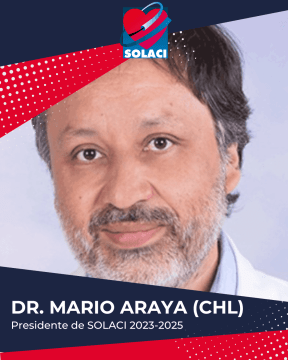
In this sense, Dr. Mario Araya (Chile)—a prestigious interventional cardiologist in our region, former Sessions Director, member of the SOLACI-LATAM Bif Registry and President of the Department of Hemodynamics of the Chilean Society of Cardiology (SOCHICAR) for 6 years—took the office of the SOLACI Presidency during the closing ceremony of the SOLACI-SBHCI 2023 Congress. He follows the successful work headed by Dr. Anibal Damonte, who led SOLACI with great effort and dedication over the past two years—a period marked by the end of the COVID-19 pandemic and the return to face-to-face events.

During his administration, Dr. Damonte led this return to face-to-face attendance at the SOLACI-SOCIME 2022 Congress, strengthened SOLACI’s links with regional and international institutions, enhanced our research records, and facilitated numerous educational and institutional activities, among which we can highlight the educational Webinars, the “MILs Train More MILs” Program, regional conferences in different Latin American countries, and the launching of the SOLACI Postgraduate Course in Hemodynamics for Technicians and Nurses. 

Dr. Araya—who worked side by side with Dr. Damonte over the past two years as SOLACI Vice-President—will ensure the continuity of all SOLACI projects, joined by Dr. Ricardo Costa (BRA) as Vice-President and Dr. Pedro Hidalgo (Venezuela) and Dr. Omar Santaera (Argentina), who remain in their roles as Secretary and Treasurer, respectively.

SOLACI will continue strengthening its institutional projects over time, fulfilling its mission to promote and expand continuing medical education in interventional cardiology in our continent.

We wish the best to the new Board of Directors!


Subscribe to our weekly newsletter

Get the latest scientific articles on interventional cardiology

More articles by this author

CHIP LATAM | Chapter 2 – Mexico: Complications Workshop

The Latin American Society of Interventional Cardiology invites the entire medical community to participate in a virtual workshop on complications organized by SOLACI’s Complex...

Fellow’s Corner 2026 – Submit Your Clinical Case

Share your experience. Learn from experts. Grow as an interventional cardiologist. The Latin American Society of Interventional Cardiology (SOLACI) is relaunching this year the Fellow’s...

Watch Again: Cardiovascular Risk Factors in Women | SOLACI Technicians Webinar

The webinar “Cardiovascular Risk Factors in Women,” held on January 27, 2026, via the Zoom platform, is now available for viewing on SOLACI’s YouTube...

Technical Training in Hemodynamics and Interventional Cardioangiology | SOLACI–CACI

The SOLACI–CACI Technical Training in Hemodynamics and Interventional Cardioangiology is an academic program designed for the initial training and professional development of non-physician healthcare...

LEAVE A REPLY

Please enter your comment!
Please enter your name here

Related Articles

SOLACI Sessionsspot_img

Recent Articles

Low-Dose Rivaroxaban After Peripheral Angioplasty: Effectiveness and Safety in Real-World Clinical Practice

Following lower limb revascularization, optimal medical therapy includes antiplatelet agents, high-intensity statins, and control of cardiovascular risk factors. Recent studies such as COMPASS and...

Sheathless Femoral Impella: A New Strategy to Reduce Vascular Complications in High-Risk PCI?

Patients with complex coronary artery disease or cardiogenic shock undergoing percutaneous coronary intervention (PCI) may benefit from the hemodynamic support provided by percutaneous ventricular...

OCT- and IVUS-Guided Coronary Angioplasty in Acute Coronary Syndrome: Long-Term Clinical Outcomes

Percutaneous coronary angioplasty (PCI) in patients with acute coronary syndrome (ACS) has reduced mortality in the acute phase. However, recurrent ACS and target vessel...