



Modelos europeos de telemedicina, como el servicio finlandés Medilux, permiten realizar consultas médicas online mediante un cuestionario clínico, sin acudir a una consulta presencial.

Changes in SOLACI Authorities During SOLACI-SBHCI 2023 Congress

After a successful scientific event where all the most important topics in current interventional cardiology were addressed, there was a change in the authorities of the Latin American Society of Interventional Cardiology for the 2023-2025 term.
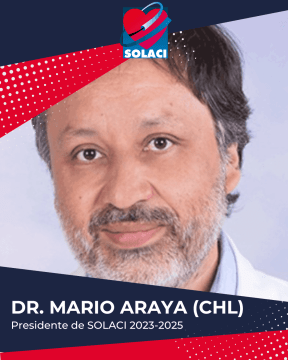
In this sense, Dr. Mario Araya (Chile)—a prestigious interventional cardiologist in our region, former Sessions Director, member of the SOLACI-LATAM Bif Registry and President of the Department of Hemodynamics of the Chilean Society of Cardiology (SOCHICAR) for 6 years—took the office of the SOLACI Presidency during the closing ceremony of the SOLACI-SBHCI 2023 Congress. He follows the successful work headed by Dr. Anibal Damonte, who led SOLACI with great effort and dedication over the past two years—a period marked by the end of the COVID-19 pandemic and the return to face-to-face events.

During his administration, Dr. Damonte led this return to face-to-face attendance at the SOLACI-SOCIME 2022 Congress, strengthened SOLACI’s links with regional and international institutions, enhanced our research records, and facilitated numerous educational and institutional activities, among which we can highlight the educational Webinars, the “MILs Train More MILs” Program, regional conferences in different Latin American countries, and the launching of the SOLACI Postgraduate Course in Hemodynamics for Technicians and Nurses. 

Dr. Araya—who worked side by side with Dr. Damonte over the past two years as SOLACI Vice-President—will ensure the continuity of all SOLACI projects, joined by Dr. Ricardo Costa (BRA) as Vice-President and Dr. Pedro Hidalgo (Venezuela) and Dr. Omar Santaera (Argentina), who remain in their roles as Secretary and Treasurer, respectively.

SOLACI will continue strengthening its institutional projects over time, fulfilling its mission to promote and expand continuing medical education in interventional cardiology in our continent.

We wish the best to the new Board of Directors!


Subscribe to our weekly newsletter

Get the latest scientific articles on interventional cardiology

More articles by this author

Everything You Need to Know About Panama Sessions 2026

After 7 years, SOLACI returns to Panama to host its 54th Regional Sessions, in collaboration with the Panamanian Association of Hemodynamics and Interventional Cardiology...

Call For Science SOLACI & SBHCI 2026 – Submit Your Work!

We invite you to submit scientific papers and challenging clinical cases for the SOLACI & SBHCI 2026 Congress, taking place from July 29 to...

FAC Webinar | CTEPH: one disease, three strategies, one team,

The Latin American Society of Interventional Cardiology (SOLACI) invites you to participate in the upcoming webinar organized by the Heart Failure Committee of the...

Mourning the passing of Dr. Eugene Braunwald

From the Latin American Society of Interventional Cardiology (SOLACI), we deeply regret the passing of Dr. Eugene Braunwald, a central figure in the development...

LEAVE A REPLY

Please enter your comment!
Please enter your name here

Related Articles

SOLACI Sessionsspot_img

Recent Articles

KISS Trial: provisional stenting in non-left main coronary bifurcations — is less more?

Coronary bifurcation angioplasty remains one of the most frequent and technically challenging scenarios in interventional cardiology. Between 15% and 20% of coronary procedures involve...

Complex radial access: a four-step protocol to overcome loops and tortuosity

Radial access is currently the preferred strategy for coronary angiography and percutaneous coronary interventions due to its lower rates of bleeding and vascular complications...

Percutaneous closure of paravalvular leaks in high-risk patients: clinical outcomes and the impact of residual leak

Paravalvular leak (PVL) is a relatively frequent complication following valve replacement (overall incidence 5–18%; 2–10% in the aortic position and 7–17% in the mitral...

