






Percutaneous coronary intervention (PCI) with drug eluting stents (DES) can present limitations, especially in the form of stent thrombosis or instent restenosis (ISR). These findings have furthered the development of drub coated balloons (DCB). The safety and efficacy of DCB have already been shown in the context of ISR and de novo small vessel coronary artery disease. At present, researchers are looking to use it for bifurcations, diffuse disease and patients at high risk of bleeding, with promising results.
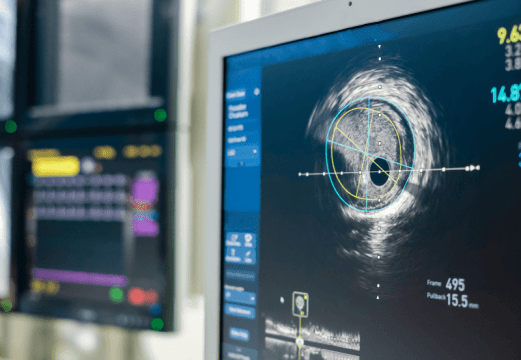
Intravascular ultrasound (IVUS) has improved clinical results in patients with left main disease, long lesions, chronic total occlusion (CTO), bifurcations and complex PCI scenarios. These findings are supported by studies such as the ULTIMATE, which has shown the clinical benefits of IVUS-guided angioplasty in an all-comers population.
This study, carried out by Gao X-F, et al., presents the ULTIMATE-III data, aimed at comparing IVUS-guided vs. angiography guided PCI with DCB in patients at high risk of bleeding.
The ULTIMATE-III was a prospective multicenter randomized open study carried out in four centers in China. It included adult patients with PCI indication for silent ischemia, stable or unstable chronic ischemia or myocardial infarction (AMI) within 48 hrs. prior randomization. Angiographically treated vessels had to be between 2.0 and 4.0 mm in diameter and ≤15 mm long. It excluded patients with longer lesions, severe calcification, left main disease, ostial lesions, CTO or those intolerant to platelet antiaggregation.
Read also: Evolution of Cardiac Damage in MitraClip.
According to protocol, there was thorough predilation, and angiographic success was defined as residual stenosis ≤30%, with TIMI III flow and no significant Type B dissection. In cases with compromised flow or severe dissection, bailout stenting was used. IVUS vessel assessment was dome with a 40 MHz transductor (Boston Scientific), looking at parameters such as minimal luminal diameter (MLD), minimal luminal area, reference luminal area and plaque burden. After 7 months of index procedure, patients were followed up angiographically.
Primary end point was late lumen loss at 7 months (LLL) defined as the difference between post procedural MLD and control MLD. Secondary end point was target vessel failure (TVF) at 6 months, defined as a composite of cardiac death, target vessel myocardial infarction and ischemia driven revascularization.
From February 2020 until December 2022, a total 260 patients were randomized to IVUS guided (n=130) or conventional angiography guided (n=130) PCI with DCB. Seven patients in the IVUS group and two from the angiography group required bailout stenting. Mean age was 68. 30.8% presented diabetes and 73.5% were included of unstable angina.
Predilation diameter was larger with IVUS (2.73±0.47 mm) vs angiography (2.57±0.50 mm). DCB dilation was also larger with IVUS (2.74±0.46 mm vs. 2.56 ±0.48 mm; P=0.005). After procedure, acute outcomes were better with IVUS, especially in terms of MLD (1.93±0.54 mm vs. 1.78 ±0.48 mm; P=0.019) and acute lumen loss (0.93±0.58 mm vs. 0.80 ±0.47 mm; P=0.038). At 7-month angiographic follow-up, patients treated with IVUS continued to show better MLD (2.06±0.62 mm vs. 1.75 ±0.63 mm; P<0.001) and less residual stenosis (28.15% vs. 35.83%; P=0.001).
TVF events were few in both arms, with 3.1% for angiography patients and 0.8% for IVUS, with no significant differences in individual components of mortality and target vessel MI.
Conclusions
The use of IVUS in de novo coronary lesions treated with DCBs showed improved luminal gain at 7 month followup, attributed mainly to a more effective plaque preparation with intravascular ultrasound. However, this benefit did not translate into significant differences in terms of clinical adverse events, considering the short followup period.
Dr. Omar Tupayachi.
Member of the Editorial Board of SOLACI.org.
Original Title: Intravascular Ultrasound vs Angiography-Guided Drug-Coated Balloon Angioplasty: The ULTIMATE III Trial.
Reference: Gao XF, Ge Z, Kong XQ, Chen X, Han L, Qian XS, Zuo GF, Wang ZM, Wang J, Song JX, Lin L, Pan T, Ye F, Wang Y, Zhang JJ, Chen SL; ULTIMATE Ⅲ Investigators. Intravascular Ultrasound vs Angiography-Guided Drug-Coated Balloon Angioplasty: The ULTIMATE Ⅲ Trial. JACC Cardiovasc Interv. 2024 Jul 8;17(13):1519-1528. doi: 10.1016/j.jcin.2024.04.014. Epub 2024 Jun 5. PMID: 38842991.
Subscribe to our weekly newsletter
Get the latest scientific articles on interventional cardiology



