






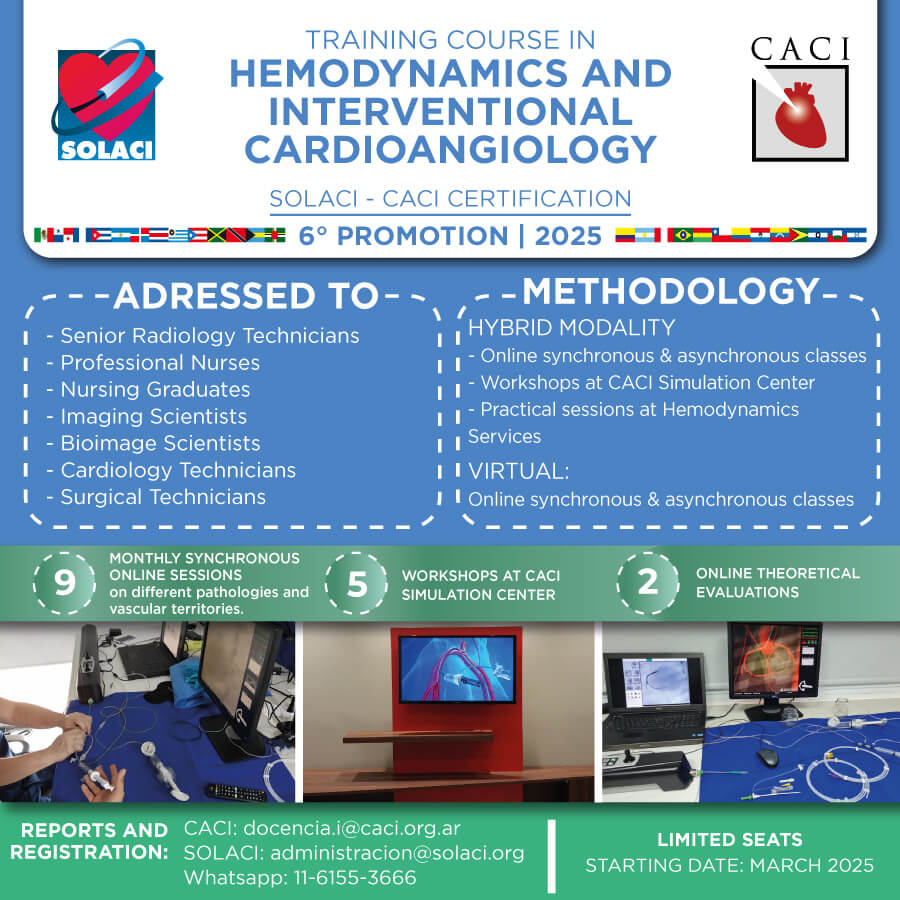
We are now open for registration to the hybrid training course on Hemodynamics and Interventional Cardioangiology for Technicians and Nurses SOLACI-CACI 2025
Find all course details below.
Modality
Hybrid.
Registration
- Start: December 10, 2024
- Finish: February 28, 2025
Duration
Annual (March to November)
Meant for
- Senior Radiology Technicians
- Professional Nurses
- Nursing Graduates
- Imaging Scientists
- Bioimage Scientists
- Cardiology Technicians
- Surgical Technicians
Objectives
To provide initial training and academic updates for non-medical staff involved in Hemodynamics Services.
Authorities
Juan Álvarez Sevillano MD, María Bayón MD
Course Format
- Monthly synchronous online classes: one Friday per month from 9 a.m. to 1 p.m.
- Biweekly asynchronous classes
- Practical classes at CACI Simulation Center
- Workshops at CACI Simulation Center (4 annual workshops)
- Practical sessions at Hemodynamics Services (30 hours)
Requirements to Pass the Course:
- 70% class attendance
-
Pass 2 online midterm exams
Enrollment Requirements
- Degree or degree in process
- CV
-
ID (Front and back)
Recertification Credits
–
Topics
- Basic notions of Cardiocirculatory Anatomy and Physiology
- Cath Lab Equipment
- Cath Lab Monitoring (EKG/ BP/ oxygen saturation)
- Health radiophysics and radioprotection
- Patient flow in the Cath Lab
- Access routes
- Contrast media
- Material preparation and sterilization
- Interventions in Heart Disease I: Diagnosis
- Interventions in Heart Disease II: Therapy
- Interventions in Structural Heart Disease
- Interventions in Peripheral Artery Disease
- Interventions in Carotid Artery Disease and Neurointervention
- Miscellaneous
- Arrhythmias, Electrophysiology, and Pacemakers
Teachers
CACI Teaching Committee: Medical Doctors Juan Arellano, María Bayón, Dionisio Chambre, Alejandro Cherro, Amalia Descalzo, Guillermo Migliaro, Juan Álvarez Sevillano, Ernesto Torresani.
Additional Description:
✔️ Two initial modules covering the basic concepts of working in a Cath Lab.
✔️ Six specific modules addressing diseases and vascular territories, each organized around angiographic anatomy, drugs, catheters, devices, etc.
✔️ A module on Electrophysiology and Pacemakers, focused on the basic aspects of the conduction system, its pathology, and current treatments
Subscribe to our weekly newsletter
Get the latest scientific articles on interventional cardiology



