

Angiography has traditionally been the primary imaging technique for endovascular therapy guidance in patients with peripheral artery disease. However, as it only provides two-dimensional images of lumen, it does not allow complete visualization of vascular structures. This can hinder appropriate selection of device size, balloon or stent, as well as the accurate assessment of procedural outcomes.
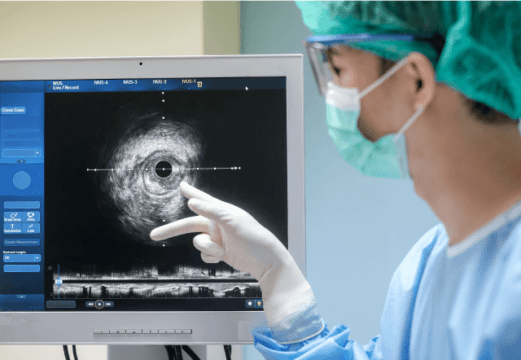
Intravascular ultrasound (IVUS) provides detailed information on vessel dimension and plaque characteristics. Its use has been shown to improve clinical outcomes in the treatment of complex coronary lesions. In recent years, IVUS has been increasingly used in peripheral artery disease; however, supporting clinical evidence vs standard angiography in peripheral artery interventions remains limited.
This prospective, multicenter, randomized study aimed to evaluate the outcomes of IVUS-guided vs angiography-guided treatment of femoropopliteal lesions with different levels of lesion complexity.
The primary endpoint was target lesion primary patency, defined as absence of clinically driven target lesion revascularization (CD-TLR) or restenosis at 12 months. The secondary endpoint included CD-TLR as well as clinical and hemodynamic improvement parameters.
A total of 237 patients undergoing drug-coated balloon angioplasty for femoropopliteal lesions were included in the IVUS-DCB study; 158 had complex lesions (TASC II type C/D) and 79 had non-complex lesions (TASC II type A/B).
In complex lesions, IVUS use was associated with significantly higher primary patency (82.1% vs. 60.3%; HR: 0.34; 95% CI: 0.16-0.70; p = 0.002), lower incidence of CD-TLR (90.0% vs. 76.9%; HR: 0.31; 95% CI: 0.13-0.75; p = 0.01), and sustained clinical and hemodynamic improvement vs angiography guided angioplasty.
As regards non-complex lesions, no significant differences were observed in primary patency (87.5% vs. 88.2%; HR: 1.84; 95% CI: 0.39-8.60; p = 0.44) or incidence of secondary evaluation criteria between IVUS and angiography-guided balloon angioplasty.
Conclusion
IVUS-guided drug coated balloon angioplasty was associated with higher primary patency rate and clinical improvement vs. the angiography-guided in the treatment of complex femoropopliteal lesions. In contrast, non-complex lesions showed no significant differences between these methods.
Original Title: Intravascular Ultrasound-Guided vs Angiography-Guided Drug-Coated Balloon Angioplasty in Patients With Complex Femoropopliteal Artery Disease.
Reference: Seung-Jun Lee, MD et al JACC Cardiovasc Interv. 2025;18:558–569.
Subscribe to our weekly newsletter
Get the latest scientific articles on interventional cardiology