



Modelos europeos de telemedicina, como el servicio finlandés Medilux, permiten realizar consultas médicas online mediante un cuestionario clínico, sin acudir a una consulta presencial.

Open Session | Current Endovascular Treatment of Tricuspid Regurgitation

SOLACI and the Argentine College of Interventional Cardioangiologists (CACI) invite you to participate in a new Open Session of the Advanced Postgraduate Course in Hemodynamics and Interventional Cardioangiology, an academic initiative designed to promote continuous education and knowledge exchange among specialists across the region.

This session will focus on the current endovascular treatment of tricuspid regurgitation, one of the fastest-growing fields in structural heart interventions, driven by the development of new technologies and therapeutic strategies for patients with limited treatment options.

The lecture will be delivered by Dr. Amat Santos (Spain), an internationally recognized expert in interventional cardiology and structural heart disease, who will share his clinical experience and review the latest evidence regarding percutaneous therapies for the management of tricuspid regurgitation.

The session will address key aspects related to patient selection, currently available technologies, clinical outcomes from recent studies, and the challenges associated with integrating these therapies into everyday clinical practice.

This activity represents an excellent opportunity to update your knowledge and gain first-hand insight into the trends that are transforming the treatment of tricuspid valve disease.

Activity Information

Topic: Current Endovascular Treatment of Tricuspid Regurgitation
Speaker: Dr. Amat Santos (Spain)
Date: June 8, 2026
Time: 08:00 AM (Argentina Time)

This is an open activity with prior registration required.
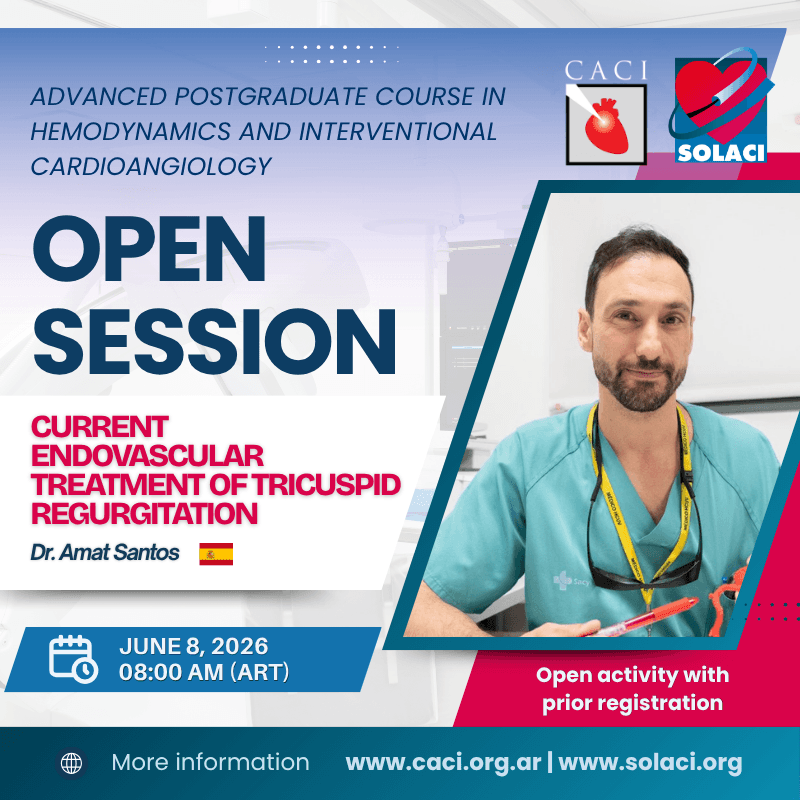
Open Session AMAT SANTOS eng

More articles by this author

06/03 | SOLACI Technicians & Nurses Webinar – Clinical Impact of Structural Interventions: TAVI and MitraClip in Current Practice

The Latin American Society of Interventional Cardiology (SOLACI), through its Technicians and Nurses Department, invites you to participate in a new scientific webinar entitled...

SOLACI Presented an Outstanding Scientific Session on Complex Coronary Lesions at EuroPCR 2026

The Latin American Society of Interventional Cardiology (SOLACI) had a prominent participation at EuroPCR 2026 through an institutional scientific session held on May 21...

Relive SOLACI’s participation in the V International Congress of Clinical and Interventional Cardiology in the Dominican Republic

The Latin American Society of Interventional Cardiology actively participated in the “V International Congress of Clinical and Interventional Cardiology”, organized by the Asociación Dominicana...

SOLACI to Participate in EuroPCR 2026 with a Scientific Session Focused on the Management of Complex Coronary Lesions

The Latin American Society of Interventional Cardiology will have a prominent participation at EuroPCR 2026 through an institutional scientific session bringing together renowned international...

LEAVE A REPLY

Please enter your comment!
Please enter your name here

Related Articles

SOLACI Sessionsspot_img
Jornadas Guatemala 2026

Recent Articles

DOUBLE-CHOICE: Lower Pacemaker Implantation Rates with ACURATE neo2 Compared with Evolut in Patients Undergoing TAVI

The DOUBLE-CHOICE trial is a multicenter, randomized, controlled study conducted in Germany to evaluate the performance of next-generation transcatheter heart valves and different anesthesia...

GLUCO-TAVI | Can Glucocorticoids Reduce the Need for Permanent Pacemaker Implantation After TAVI?

Despite the expansion of transcatheter aortic valve implantation (TAVI) indications, cardiac conduction disturbances (CCD) and the need for permanent pacemaker implantation (PPI) remain the...

EuroPCR 2026 | TAVI in Women: Do Supra-Annular Valves Offer a True Hemodynamic Advantage?

Women represent a particularly challenging population for TAVI, as they often have smaller aortic annuli, greater frailty, and an increased risk of prosthesis-patient mismatch....


