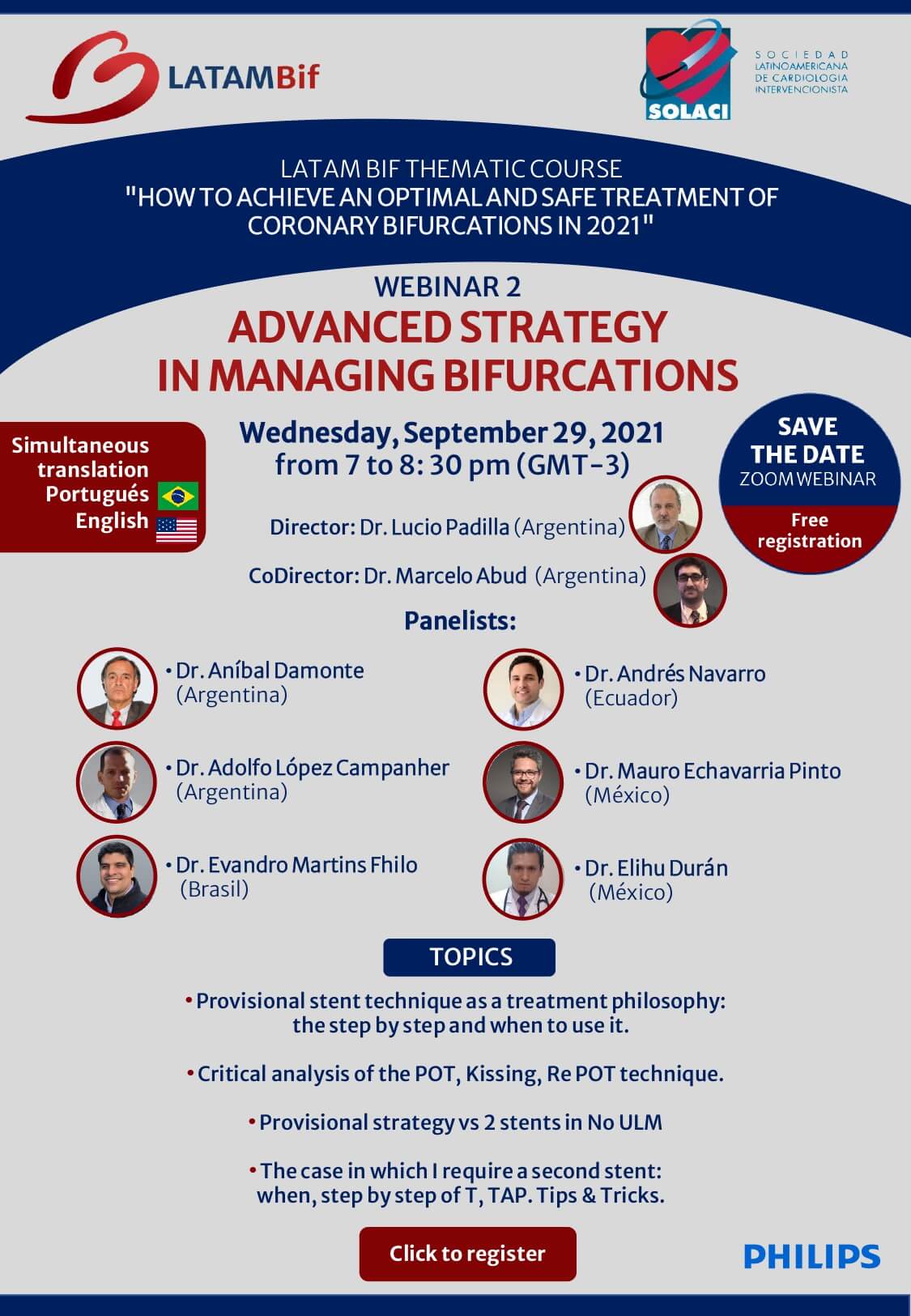
SOLACI-LATAM Bif Webinar | Advanced Strategy in Managing Bifurcations


Subscribe to our weekly newsletter

Get the latest scientific articles on interventional cardiology

More articles by this author

V International Course on Cardiovascular Interventionism – SOLACI Scientific Endorsement

The Latin American Society of Interventional Cardiology (SOLACI) proudly grants its scientific endorsement to the V International Course on Cardiovascular Interventionism, an important academic...

Plaque Ruptures in Non-Culprit Arteries: Follow-Up With Intravascular Imaging

Plaque rupture remains one of the most important pathophysiological mechanisms in acute coronary syndromes. However, not all ruptures manifest clinically as ischemia, myocardial infarction,...

Guatemala Sessions 2026 – Young Interventional Cardiologists Contest – Submit Your Case

The call for applications to participate in the Young Interventional Cardiologists Competition at the Guatemala 2026 Regional Sessions is now open. The event will...

OCT-Detected High-Risk Plaques Predict Recurrent Events After Myocardial Infarction

After a myocardial infarction (MI), non-culprit lesions are often deferred when they are not flow-limiting (negative FFR). However, these lesions continue to represent an...

LEAVE A REPLY

Please enter your comment!
Please enter your name here

Related Articles

SOLACI Sessionsspot_img
Jornadas Guatemala 2026

Recent Articles

EARLY TAVR: Impact of Age on Outcomes of Early TAVR in Asymptomatic Patients

Asymptomatic severe aortic stenosis represents an increasingly common clinical challenge. Although current guidelines recommend intervention once symptoms develop or left ventricular dysfunction occurs, concerns...

Plaque Ruptures in Non-Culprit Arteries: Follow-Up With Intravascular Imaging

Plaque rupture remains one of the most important pathophysiological mechanisms in acute coronary syndromes. However, not all ruptures manifest clinically as ischemia, myocardial infarction,...

Drug-Eluting Stents in Peripheral Arterial Disease: When Should They Be Used?

Peripheral drug-eluting stents have transformed the treatment of peripheral arterial disease by reducing restenosis rates and the need for repeat interventions. However, the emergence...