



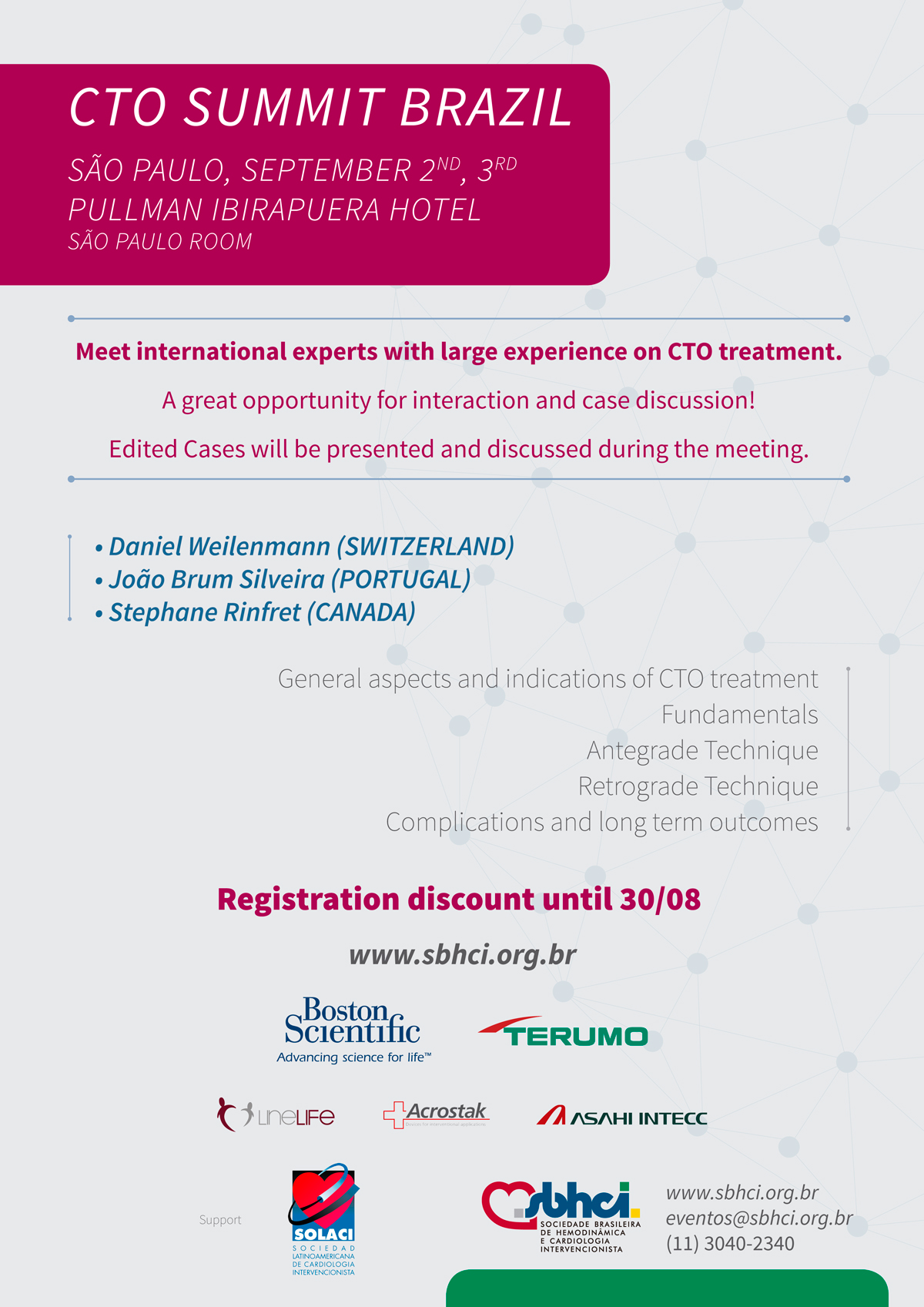
Chronic Total Occlusion Summit in Brazil

summit cto


Save the Date:

Septiembre 2nd. and 3rd.

Pullman Ibirapuera – São Paulo Room.

Organiza: SBHCI.

SBHCI, with SOLACI’s support, invites you to participate of the CTO Summit, that will take place on September 2nd and 3rd, 2016 in San Paulo, Brazil.


Schedule:

SEPTEMBER 2ND


08h30 – Opening Remarks


GENERAL ASPECTS AND INDICATIONS OF CTO TREATMENT


08h40 CTO epidemiology and indications: which patients may benefit

09h00 CTO angiography anatomy: the clue to the strategy

09h20 CTO nomenclatureand CTO toolbox

09h40 Case presentation and discussion

10h10 Coffee Break


CTO FUNDAMENTAL ASPECTS


10h40 How to set up a CTO program

11h00 Wire selection and wire manipulation

11h20 Accessory devices and image methods

11h40 Case presentation and discussion

12h10 Adjourn


12h20 Lunch


ANTEGRADETECHNIQUES IN CTO PCI


14h00 Antegrade techniques and limitations

14h20 Case presentation and discussion

14h50 Antegradedissection-reentry technique (ADR)

15h10 Case presentation and discussion

15h40 Case presentation and discussion


16h10 Coffee Break


RETROGRADE TECHNIQUES IN CTO PCI


16h40 Retrograde technique: thebasics

17h00 CART and reverse CART

17h20 Case presentation and discussion

17h50 The hybrid algorithm in clinical practice

18h10 Case presentation and discussion

18h40 Adjourn


SEPTEMBER 3RD


COMPLICATIONS AND LONG TERM OUTCOMES IN CTO PCI


08h30 Complications: from prevention to management

08h50 Case presentation and discussion

09h20 Septal complications

09h40 Case presentation and discussion


10h10 Coffee Break


10h40 Long–term outcomes of CTO treatment

11h00 Case presentation and discussion

11h30 X Ray and contrast dye issues and management in CTO PCI

11h50 Challenges in sustaining asuccessful CTO program – open discussion with the faculty

12h10 Closingremarks

12h20 Adjourn


If you want to register and need further information about registration fees, please click

 

More articles by this author

V International Course on Cardiovascular Interventionism – SOLACI Scientific Endorsement

The Latin American Society of Interventional Cardiology (SOLACI) proudly grants its scientific endorsement to the V International Course on Cardiovascular Interventionism, an important academic...

Guatemala Sessions 2026 – Young Interventional Cardiologists Contest – Submit Your Case

The call for applications to participate in the Young Interventional Cardiologists Competition at the Guatemala 2026 Regional Sessions is now open. The event will...

Watch Again: Clinical Implications of Structural Heart Interventions — TAVI and MitraClip in Daily Practice

The recording of the webinar “Structural Interventions: TAVI and MitraClip in Daily Practice” is now available on the SOLACI YouTube channel. The activity was...

06/03 | SOLACI Technicians & Nurses Webinar – Clinical Impact of Structural Interventions: TAVI and MitraClip in Current Practice

The Latin American Society of Interventional Cardiology (SOLACI), through its Technicians and Nurses Department, invites you to participate in a new scientific webinar entitled...

LEAVE A REPLY

Please enter your comment!
Please enter your name here

Related Articles

SOLACI Sessionsspot_img
Jornadas Guatemala 2026

Recent Articles

EARLY TAVR: Impact of Age on Outcomes of Early TAVR in Asymptomatic Patients

Asymptomatic severe aortic stenosis represents an increasingly common clinical challenge. Although current guidelines recommend intervention once symptoms develop or left ventricular dysfunction occurs, concerns...

Plaque Ruptures in Non-Culprit Arteries: Follow-Up With Intravascular Imaging

Plaque rupture remains one of the most important pathophysiological mechanisms in acute coronary syndromes. However, not all ruptures manifest clinically as ischemia, myocardial infarction,...

Drug-Eluting Stents in Peripheral Arterial Disease: When Should They Be Used?

Peripheral drug-eluting stents have transformed the treatment of peripheral arterial disease by reducing restenosis rates and the need for repeat interventions. However, the emergence...

