






Severe coronary calcification remains one of the most challenging scenarios in percutaneous coronary intervention (PCI). Although rotational or orbital atherectomy and intravascular lithotripsy (IVL) are valuable plaque-modification techniques, no single strategy is suitable for every pattern of coronary calcium. In this context, combining atherectomy followed by IVL may be beneficial in lesions where an “IVL-first” approach is not feasible or when performing more aggressive atherectomy could substantially increase procedural risk.
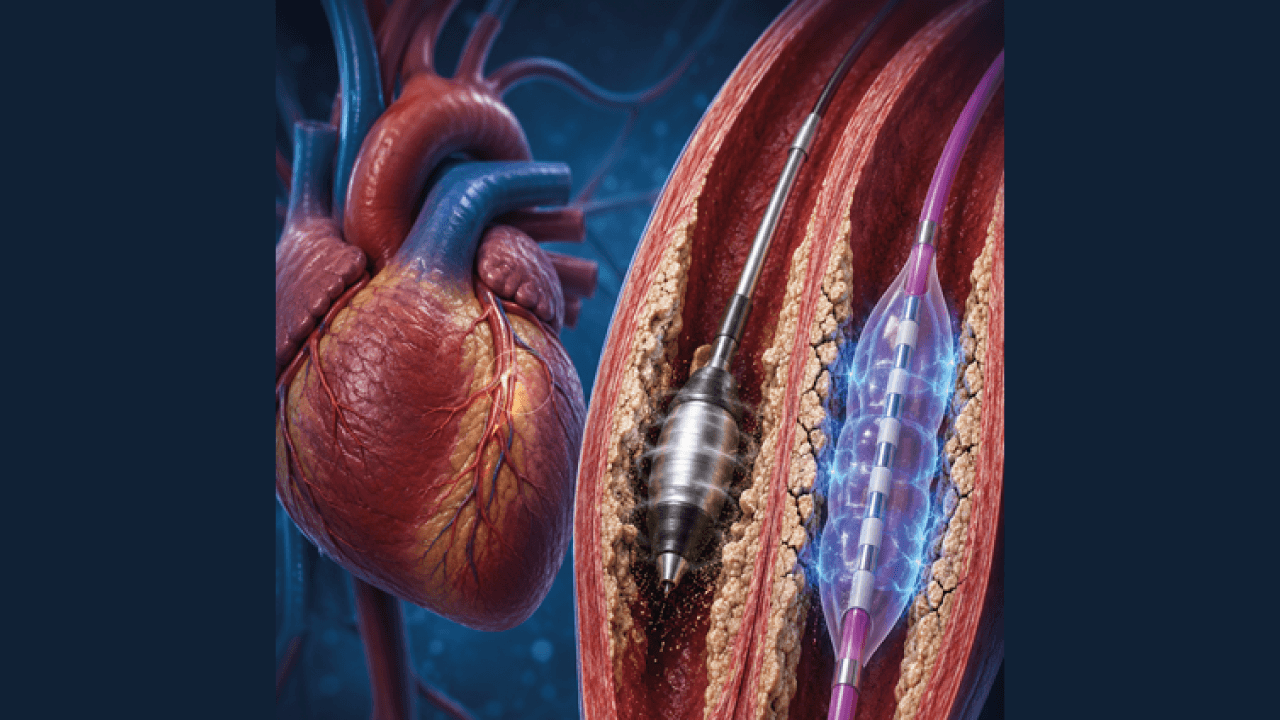
The aim of the Dual-Prep Registry was to evaluate the one-year clinical outcomes of the combined use of atherectomy and IVL in severely calcified coronary lesions. This was a prospective, multicenter, single-arm registry conducted across 20 centers in Japan. A total of 118 patients with 120 lesions were included. IVL was performed after atherectomy whenever lesion preparation remained inadequate.
The mean patient age was 75.8 years; 56.8% had diabetes, 25.4% were receiving hemodialysis, and 41.7% had calcified nodules. Rotational atherectomy was performed in 83.9% of cases (mean burr size: 1.57 ± 0.20 mm), while orbital atherectomy was used in 16.9%. Following atherectomy, all lesions still had a calcium score of 4.0. Drug-eluting stents (DES) were implanted in all cases, with OCT/OFDI guidance used in 90.8%, achieving an overall procedural success rate of 97.5%.
One-year follow-up was available for 99.2% of patients. MACE-free survival was 92.3% (95% CI: 85.8–95.9%), while freedom from target lesion revascularization (TLR) was 94.8% (95% CI: 88.9–97.7%). The overall incidence of MACE was 7.6%, including cardiac death in 2.5%, myocardial infarction in 5.1%, and clinically indicated target vessel revascularization in 5.1%. Definite stent thrombosis was uncommon, occurring in only one patient (0.8%).
Predictor analysis showed that residual stenosis after stent implantation and treated reference vessel diameter were associated with a higher incidence of MACE. For every 5% increase in residual stenosis, the risk of MACE increased 2.3-fold. Likewise, each 1-mm increase in treated reference vessel diameter was also associated with a 2.3-fold increase in MACE risk. Diabetes, hemodialysis, atherectomy type, and the presence of calcified nodules were not significantly associated with clinical events in this registry.
Conclusions: Combined Atherectomy and IVL Achieves High Procedural Success and Low One-Year Event Rates
In this prospective registry, the combined strategy of atherectomy followed by IVL achieved a high procedural success rate and low one-year rates of MACE, TLR, and stent thrombosis in patients with severely calcified coronary lesions. These observational findings support its selective use in cases where an initial IVL strategy may not be feasible or where more aggressive atherectomy could increase procedural risk.
Original Title: Dual-Prep registry: Atherectomy devices and intravascUlAr lithotripsy for the PREParation of heavily calcified coronary lesions registry, 1-year results.
Reference: Nakamura, M., Kuriyama, N., Tanaka, Y. et al. Dual-Prep registry: Atherectomy devices and intravascUlAr lithotripsy for the PREParation of heavily calcified coronary lesions registry, 1-year results. Cardiovasc Interv and Ther 41, 530–539 (2026). https://doi.org/10.1007/s12928-026-01264-4.



