






Courtesy of Dr. Javier Castro.
Certain coronary lesions have been historically discouraged for endovascular treatment. Among these can be found left main coronary artery lesions, multivessel disease, and proximal anterior descending artery lesions. As a matter of fact, the latter is actually considered separately as a criterion for choosing the revascularization method.
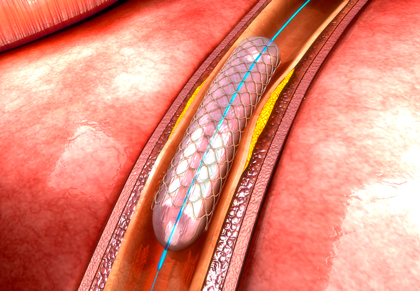 Endovascular treatment of proximal anterior descending artery lesions, associated or not with lesions in other vessels, is not homogeneously recommended by European and American guidelines, and its long-term results are somewhat unknown.
PROTECT (Patient Related Outcomes with Endeavor Versus Cypher Stenting Trial) is a multicenter, multinational, open trial that randomized patients who underwent coronary angioplasty (both urgent and elective) with an Endeavor device (Medtronic Santa Rosa, California) vs. a Cypher device (Cordis Johnson & Johnson, Florida). Enrollment took place from May 2007 to December 2008.
This article compared the 4-year outcomes of 2534 patients with stents implanted in the proximal anterior descending artery and 6172 patients with stents implanted in other sites.
Results:
Major adverse cardiac events (MACE; all-cause death, myocardial infarction, and repeat revascularization) were more frequent among patients in the proximal anterior descending artery group, particularly at the 1-, 2-, and 3-year follow-up. However, this trend did not apply to the 4-year follow-up (15% vs. 13.7%; p = 0.139).
At 30 days, cardiac mortality was higher in the proximal anterior descending artery group (0.6% vs. 0.3%; p = 0.035), but that changed for the long-term follow-up (3.6% vs. 3.0%; p = 0.132).
Target vessel failure (TVF; cardiac death, target-artery myocardial infarction, or clinically driven repeat revascularization) at the 4-year follow-up was similar among groups (14.8% vs. 13.5%; p = 0.127).
The incidence of myocardial infarction was significantly higher in the proximal anterior descending artery group (6.2% vs. 4.9%; p = 0.015).
Stent thrombosis (ST), both probable and definitive, was similar for both groups: 1.2% vs. 0.8% (p = 0.19) at the 1-year follow-up, and 2.1% vs. 2.0% at the 4-year follow-up (p = 0.28).
ST, both probable and definitive, presented lower incidence among patients with a zotarolimus-eluting stent (E-ZEZ). That was the case for patients in the proximal anterior descending artery group (1.5% vs. 2.7%; p = 0.050) and in the other implantation site group (1.6% vs. 2.4%; p = 0.072).
There were no other significant differences in outcome between devices, in neither group.
The multivariate analysis showed the proximal anterior descending artery as an independent predictor of myocardial infarction at the 4-year follow-up (p = 0.38), but not of TVF (0.149) or MACE (p = 0.069).
The authors conclude that, in patients treated with angioplasty and drug-eluting stents, implantation in the proximal anterior descending artery does not imply a prognosis different than that for other sites.
Editorial:
The results observed in this trial imply that, currently, proximal anterior descending artery lesions do not entail higher risk than other lesions, considering the described cohort as a high-risk population, since over 50% of patients had acute coronary syndrome or multivessel disease, and 30% had diabetes.
It should be noted that the proximal anterior descending artery group, due to its demographic characteristics, apparently presented lower risk, since patients were younger, there was a lower percentage of smokers, lower hypertension, and lower percentage of prior angioplasty or myocardial revascularization surgery (MRS).
However, this patient group presented more bifurcation lesions, treated lesions, implanted stents, and total stent length per patient.
Most patients received dual therapy with aspirin and clopidogrel, a fact that must be thoroughly considered, since this treatment, compared to current anti-platelet therapies, could offer a significant difference in outcomes: lower rates of myocardial infarction, ST, TVF, and MACE.
It should also be noted that this study used first-generation stents, which could result in lower benefit as regards hard events. In fact, stent thrombosis (definitive or probable) was lower among patients that received the Endeavor device than among those who received the Cypher device in both patient groups (proximal anterior descending artery and other implantation sites).
Courtesy of Dr. Javier Castro.
Original title: Long-Term Outcomes of Stenting the Proximal Left Anterior Descending Artery in the PROTECT Trial.
Reference: J Am Coll Cardiol Intv 2017;10:548-556
Get the latest scientific articles on interventional cardiologySubscribe to our weekly newsletter
We are interested in your opinion. Please, leave your comments, thoughts, questions, etc., below. They will be most welcome.



