Interventional cardiologists face one of the most extreme occupational hazards: ionizing radiation. The right radial access (RRA) has been established as the preferred alternative due to its safety and efficiency profile. However, it has been associated with higher radiation exposure compared to the transfemoral approach. Some studies have assessed how the use of the left radial approach (LRA) correlates with lower radiation doses compared to the RRA, as demonstrated by the RADIANT and OPERA studies.
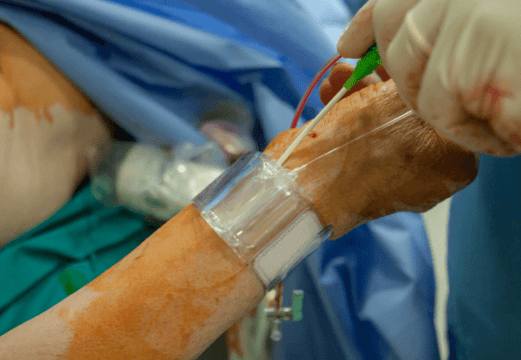
The hyper-adducted right radial artery (HARRA) position requires placing the right arm as close as possible to the patient’s flank (as opposed to the abducted position, which has been shown to result in up to ten times higher exposure). The aim of this study was to compare the radiation exposure for the first operator (both cumulative and normalized) between the standardized HARRA position and a conventional left radial approach.
Researchers conducted a single-center randomized study at Maimonides Medical Center (New York). It included 534 patients undergoing elective coronary angiography, assigned to either the LRA group (n = 269) or the HARRA group (n = 265). Patients with acute coronary syndromes or hemodynamic instability were excluded.
All procedures were performed from the patient’s right side, using both conventional and distal radial access, with custom supports or specific holding devices. Dosimeters were placed on the operator’s chest, abdomen, and both eyes: these devices were meant to assess both cumulative radiation (CR) and radiation normalized by dose-area product (CR/DAP).
The results were conclusive: the use of LRA was associated with lower radiation levels in all assessed locations. In the chest, the mean exposure was 9.66 μSv vs. 12.27 μSv with HARRA (p <0.001); in the abdomen, 27.46 μSv vs. 36.56 μSv (p <0.001); and in the left eye, 2.65 μSv vs. 3.77 μSv (p <0.001).
Read also: 5th Generation Balloon Expandable Valve in a Real World US Population: One-Year Outcomes.
A subsequent multivariate analysis confirmed that HARRA access was still significantly associated with higher exposure, even after adjusting for variables such as distal access.
Conclusion
Compared to the hyper-adducted right radial technique, use of the left radial access resulted in a significant reduction in ionizing radiation exposure during diagnostic catheterizations. This evidence supports that operators can reduce their exposure by adopting a left radial approach.
Reference: Casazza R, Malik B, Hashmi A, Fogel J, Montagna E, Frankel R, Borgen E, Ayzenberg S, Friedman M, Moskovits N, Verma S, Meng J, Chang N, Huang Y, Rodriguez C, Chera HH, Raj S, Chaterjee S, Gibson D, Palacios A, Agarwal C, Nene MV, Shani J. Operator Radiation Exposure Comparing the Left Radial Artery Approach and a Uniform Hyper-Adducted Right Radial Artery Approach: The HARRA Study. Circ Cardiovasc Interv. 2025 Apr;18(4):e014602. doi: 10.1161/CIRCINTERVENTIONS.124.014602. Epub 2025 Mar 19. PMID: 40104858; PMCID: PMC11995851.
Subscribe to our weekly newsletter
Get the latest scientific articles on interventional cardiology