Courtesy of Dr. Juan Manuel Pérez.
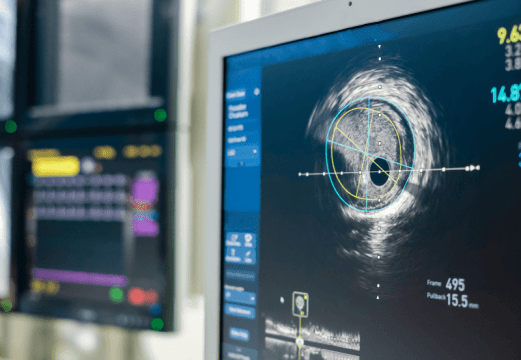
Acute coronary obstruction (ACO) is a rare but potentially fatal complication following transcatheter aortic valve implantation (TAVI), particularly in valve-in-valve (ViV) procedures. While it can be prevented through the use of chimney stents, their placement is still risky and often proves unnecessary. Angiography, with its limitations regarding the assessment of valve leaflets and coronary ostia, may underestimate the true risk. In this context, intravascular ultrasound (IVUS) emerges as a more precise tool to guide the actual need for stenting.
ICARO, a prospective, multicenter, observational study, included 32 patients (mean age: 83 years; 56.3% women), with a total of 40 coronary vessels considered at high risk of ACO, based on the presence of at least two anatomical criteria identified via CT imaging. In patients undergoing TAVI on native valves (25%), the main findings were low-lying ostia (<9 mm), narrow sinuses of Valsalva (<30 mm in 78.1% on the left side and 84.3% on the right), and valve leaflets extending beyond the left (93.8%) and right (53.1%) coronary ostia.
In ViV procedures (75%), there were unfavorable surgical bioprostheses in 75% of cases (either stentless or with externally mounted leaflets), low left coronary ostium (93.8%), virtual transcatheter heart valve-to-coronary distance (VTC <4 mm) in 65.6% of left vessels and 25% of right vessels, as well as virtual transcatheter heart valve-to-sinotubular junction distance (VT-STJ <3.5 mm) in 59.4% of cases on the left vessels and 15.6% of cases on the right vessels.
The primary aim of the study was to assess the feasibility and safety of IVUS in guiding the need for chimney stent implantation after TAVI. In 38 out of 40 vessels (95%), IVUS was feasible and used without complications. Two patients (5%) required urgent stent implantation due to immediate coronary obstruction following valve deployment.
Read also: Transcatheter Tricuspid Valve Replacement: 1-Year Outcomes.
The use of IVUS resulted in no stent implantation in 63.2% of cases (24 out of 38 vessels). After one year, the incidence of major adverse cardiovascular events (MACE) was 6.2% in both the stented and non-stented groups (p = 0.964). The concordance between angiography and IVUS was 74%, highlighting the higher sensitivity of IVUS in detecting an actual risk for obstruction.
IVUS findings most frequently associated with the need for angioplasty included a minimal luminal area in the ostial-paraostial space <9.5 mm² (p = 0.044), a minimal ostial diameter <3.9 mm (p = 0.005), and a distance between the displaced leaflet and the ostium <3 mm (p = 0.010).
Conclusion
The ICARO study demonstrates that using IVUS after TAVI in patients at high risk of coronary obstruction is a safe, feasible, and clinically valuable strategy for avoiding unnecessary chimney stent implantation, without compromising medium-term clinical outcomes.
Original Title: Intravascular Ultrasound Assessment of Coronary Arteries at High Risk for Obstruction Following TAVR: The ICARO Study.
Reference: Lunardi M., Pesarini G., Cubich M., Dumonteil N., Abdel-Wahab M., Mylotte D., Castriota F., Laforgia P., Fezzi S., Scarsini R., Ribichini F. JACC: Cardiovascular Interventions. 2025;18(9):1147–1160. https://doi.org/10.1016/j.jcin.2025.03.016.
Subscribe to our weekly newsletter
Get the latest scientific articles on interventional cardiology