






The Latin American Society of Interventional Cardiology (SOLACI) and the Argentine College of Interventional Cardioangiologists (CACI) announce the opening of registration for Module 2 of the 2026 Annual Course, dedicated to Multislice Computed Tomography (CT) and Cardiovascular Magnetic Resonance Imaging (CMR), two essential tools for the diagnosis, therapeutic planning, and follow-up of patients with cardiovascular diseases.
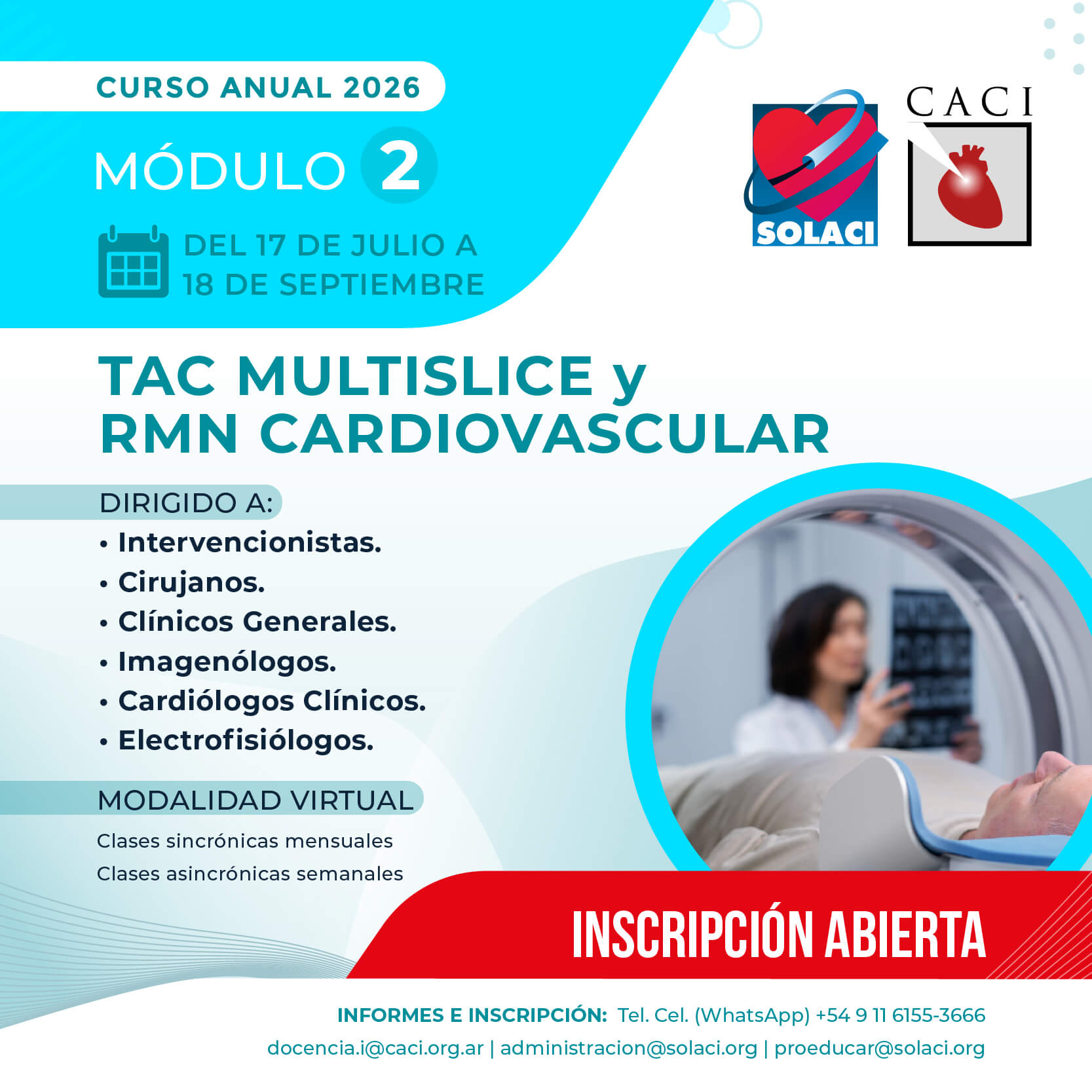
This module is part of a comprehensive educational program designed to provide rigorous and practical training in advanced cardiovascular imaging techniques, whose role continues to expand in contemporary cardiology and clinical and interventional decision-making.
Throughout the course, participants will review key concepts and clinical applications of cardiac CT and cardiovascular MRI, including anatomical and functional cardiac assessment, tissue characterization, evaluation of coronary artery disease, structural heart disease, and other complex cardiovascular conditions.
The activity is intended for interventional cardiologists, cardiovascular surgeons, clinical cardiologists, imaging specialists, general practitioners, and electrophysiologists, as well as healthcare professionals interested in expanding their knowledge of imaging modalities that have become a cornerstone of modern cardiovascular practice.
The course will be delivered entirely online, combining monthly live sessions with weekly on-demand educational activities, allowing participants to access up-to-date content while maintaining their professional responsibilities.
Course Information
Course: 2026 Annual Course – Module 2
Topic: Multislice CT and Cardiovascular Magnetic Resonance Imaging
Format: Virtual
Start Date: July 17, 2026
End Date: September 18, 2026
Target Audience
- Interventional Cardiologists
- Surgeons
- General Practitioners
- Imaging Specialists
- Clinical Cardiologists
- Electrophysiologists
Educational Format
- Monthly live online sessions
- Weekly asynchronous classes
Places are limited and registration is now open.
For further information and registration:
📧 docencia.i@caci.org.ar
📧 administracion@solaci.org
📧 proeducar@solaci.org
📱 WhatsApp: +54 9 11 6155-3666



 and the Argentine College of Interventional Cardioangiologists (CACI) announce the opening of registration for Module 2 of the 2026 Annual Course, dedicated to Multislice Computed Tomography (CT) and Cardiovascular Magnetic Resonance Imaging (CMR), two essential tools for the diagnosis, therapeutic planning, and follow-up of patients with cardiovascular diseases.)