






The use of ultravascular ultrasound (IVUS) to guide coronary angioplasty procedures (PCI) has been shown to reduce the risk of major adverse events in numerous randomized controlled studies, registries and meta-analysis.
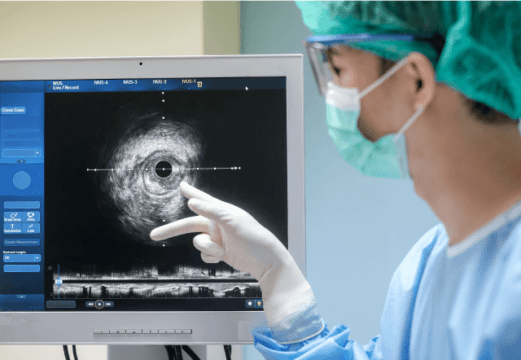
The current guidelines recommend the use of IVUS in left main disease and complex lesions. The proportion of complex PCI procedures has increased over time, as well as operator experience.
Several studies have shown high volume centers, or those with experienced operators, are associated with a significant reduced risk of major adverse cardiovascular events vs. low volume centers or those with less experienced operators.
The aim of this retrospective, observational study was to to evaluate the influence of operator experience on lesion complexity, long-term clinical outcomes, and the interactions of IVUS guidance in patients undergoing complex PCI.
Primary end point was a combination of cardiovascular death or target vessel MI (TVMI) at 10 years. Secondary end point included cardiac death rate at 10 years, acute MI, TVMI, definite or probable stent thrombosis and ischemia driven target lesion revascularization (TLR).
From the total of patients with complex coronary artery disease, 63.4% received PCI from experienced operators, while 36.6% received PCI from less experienced operators.
Experience operators used IVUS more frequently in complex lesions and had higher annual volume of PCI vs. less experienced operators. Also, more experience operators presented higher SYNTAX score, higher number and longer lesions, with more left main compromise. Patients receiving IVUS guided PCI were younger, and had fewer cardiovascular risk factors, and prior MI and cardiovascular events.
As regards outcomes, experienced operators saw lower risk of cardiac death or TVMI vs. less experienced operators (HR: 0.779; CI 95%: 0.663-0.915; P = 0.002). The use of IVUS was associated with a significant lower risk of cardiac death and TVMI vs angiography guided PCI, both for less experienced (23.5% vs 11.4%; HR: 0.477; CI 95%: 0.337-0.673; P < 0.001) and more experienced operators (18.0% vs 13.5%; HR: 0.747; CI 95%: 0.559-0.998; P = 0.048). There was a significant interaction for the risk of cardiac death or TVMI between the use of IVUS and operator experience (P=0.037).
Conclusion
Between patients with complex CAD, the use of IVUS guided PCI was associated with better long term outcomes vs. angiography guided PCI, regardless operator experience. Also, the beneficial effects of IVUS were more prominent when complex PCI procedures were carried out by less experienced operators.
Dr. Andrés Rodríguez.
Member of the Editorial Board of SOLACI.org.
Original Title: Prognostic Impact of Operator Experience and IVUS Guidance on Long-Term Clinical Outcomes After Complex PCI.
Reference: Ki Hong Choi, MD, PHD et al J Am Coll Cardiol Intv 2023;16:1746–1758.
Subscribe to our weekly newsletter
Get the latest scientific articles on interventional cardiology



