






Letter to the editor: Juan Manuel Pérez Asorey
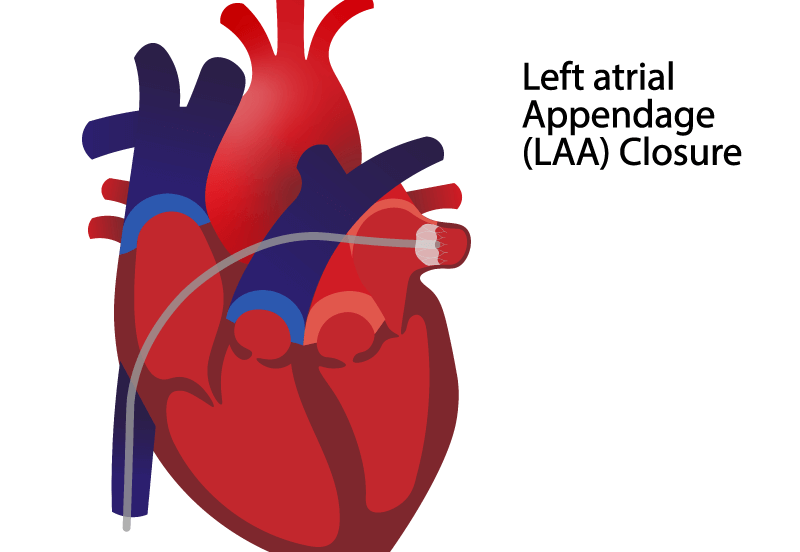
Percutaneous left atrial appendage closure (LAAO) is currently going through one of the most interesting stages of its evolution. The nearly simultaneous publication of two high-impact randomized trials—CHAMPION-AF and CLOSURE-AF—offers results that, at first glance, seem to pull in opposite directions. However, rather than representing a contradiction, they likely reflect two different ways of looking at the same strategy.
Left atrial appendage closure (LAAO) vs anticoagulation: key insights from CHAMPION-AF and CLOSURE-AF
CHAMPION-AF shows the most favorable side of LAAO. In a population eligible for anticoagulation, with low bleeding risk and a relatively “ideal” profile, left atrial appendage closure proved to be non-inferior to NOACs in preventing cardiovascular death, stroke, or systemic embolism, with a significant reduction in bleeding. This is a strong result, as it positions LAAO not only as an alternative, but as a direct competitor to standard therapy for the first time. However, a closer look reveals some important considerations: the reduction in bleeding was mainly driven by non-major events, and ischemic stroke was numerically higher in the device group. In other words, the results are favorable, but not perfect, and must be interpreted carefully.
CLOSURE-AF, on the other hand, shows a different side of the issue. In an older population with more comorbidities and higher bleeding risk, LAAO failed to demonstrate non-inferiority compared with optimized medical therapy, with high DOAC use. At first glance, this may be interpreted as a negative result for left atrial appendage closure. In this context, the present analysis revisits and builds upon the key concepts developed by Dr. Pablo Lamelas in his reflection on the interpretation of randomized trials, offering a critical perspective that helps better understand the true implications of these findings.
Lamelas highlights a key point: “failing to demonstrate non-inferiority” does not mean that LAAO is inferior, but rather that the study could not prove it was sufficiently comparable to medical therapy within the predefined margin. He also emphasizes an important issue: the study endpoint combines events of different nature (stroke, major bleeding, death), which do not carry the same clinical weight and may not move in the same direction.
When looking at individual outcomes, the most relevant finding is that stroke rates were virtually identical in both groups. This is crucial, as it indicates that LAAO does fulfill its primary objective—preventing embolic events. So why was the overall result not favorable? Likely because the procedure carries an “upfront cost” (periprocedural complications and the need for antithrombotic therapy in the first months), which impacts overall outcomes, especially in a more fragile population. In other words, the issue does not seem to be whether LAAO works, but rather in which patients and in what context it is being used.
Which patients benefit most from LAAO? Clinical interpretation and patient selection in atrial fibrillation
So, what conclusions can we draw when integrating both studies? CHAMPION-AF and CLOSURE-AF do not answer the same question. The former shows that LAAO can compete with anticoagulation in well-selected patients; the latter reminds us that in more complex patients, the benefit is less clear and the procedural cost weighs more heavily.
From a practical standpoint, the message is quite clear: LAAO is not (at least for now) a universal replacement for anticoagulation, but neither is it a strategy limited only to extreme cases. Its true value lies in proper patient selection. Those with a true contraindication, high and difficult-to-manage bleeding risk, or adherence issues remain clear candidates. However, an intermediate group is also emerging, in which both options deserve to be considered and discussed.
Ultimately, rather than providing a definitive answer, these studies help better frame the problem. They push us away from one-size-fits-all solutions and toward more individualized decision-making. Because if there is one clear takeaway from CHAMPION-AF and CLOSURE-AF, it is that left atrial appendage closure is not an all-or-nothing strategy—it is, precisely, the two sides of the same coin.
Reference: Expert opinion – Dr. Pablo Lamelas: https://cardiomics.club/2026/03/22/rethinking-the-interpretation-of-randomized-trials-a-reflection-on-closure-af/
Subscribe to our weekly newsletter
Get the latest scientific articles on interventional cardiology



 atraviesa hoy uno de los momentos más interesantes de su evolución. La publicación casi simultánea de dos ensayos randomizados de alto impacto —CHAMPION-AF y CLOSURE-AF— ofrece resultados que, en apariencia, tironean en direcciones opuestas.)