






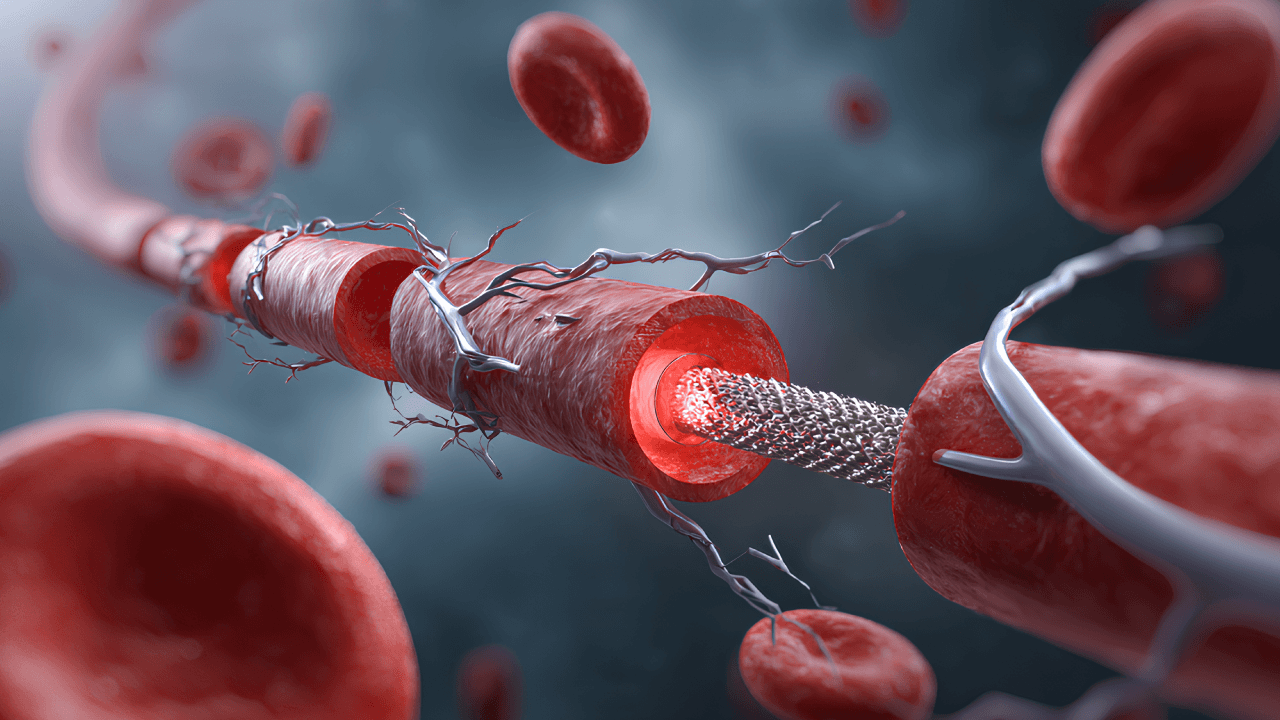
Severe calcification remains one of the main predictors of restenosis and the need for repeat revascularization following endovascular treatment of femoropopliteal disease. In this setting, the interwoven nitinol Supera stent provides high radial strength and excellent resistance to deformation, whereas Eluvia, a polymer-based paclitaxel-eluting stent, is designed to reduce neointimal hyperplasia through sustained drug release.
 Although both devices had previously shown favorable outcomes individually, direct long-term comparisons in severely calcified lesions were lacking. The aim of this study was to compare the 3-year clinical outcomes of these two treatment strategies.
The primary endpoint was freedom from target lesion revascularization (TLR) at 3 years. Secondary endpoints included primary patency, overall survival, limb salvage, and the angiographic pattern of restenosis.
A total of 257 consecutive patients from eight centers in Japan who underwent treatment between April 2018 and December 2021 for severely calcified femoropopliteal lesions (PACSS grade 3 or 4) were analyzed. Of these, 123 received Supera stents and 134 received Eluvia stents. Mean lesion length was 167 ± 101 mm in the Supera group and 163 ± 97 mm in the Eluvia group.
Chronic total occlusions accounted for 39% and 35% of lesions, respectively, while PACSS grade 4 calcification was present in 75% and 78% of cases. The mean follow-up period was 34.3 ± 23.6 months.
Read also: Is IVUS Always Necessary for Left Main Coronary Artery PCI?
At 3 years, freedom from TLR was similar between both devices (80.2% vs. 78.2%; p=0.868). Likewise, no significant differences were observed in primary patency (69.6% vs. 78.8%; p=0.558), overall survival (72.8% vs. 55.2%; p=0.110), or limb salvage (96.0% vs. 93.0%; p=0.792).
During follow-up, 42 patients (30.4%) died and 8 limbs (5.7%) required major amputation, with no differences attributable to the type of stent implanted and no device-related deaths.
Interaction analysis identified age and lesion length as potential modifiers of the relative performance of the two devices, suggesting a possible advantage of Supera in patients younger than 75 years and in lesions measuring ≥200 mm (interaction p=0.049 and 0.045, respectively).
Read also: Dual-Prep Registry: Atherectomy and IVL for Severe Coronary Calcification.
Regarding restenosis morphology, recurrences occurring within the first year showed a trend toward more occlusive patterns in the Eluvia group (50% vs. 13%; p=0.059), whereas no differences were observed between devices for late restenosis (p=1.000).
Conclusion: Supera and Eluvia Showed Comparable 3-Year Outcomes in Severely Calcified Femoropopliteal Lesions.
In conclusion, Supera and Eluvia stents demonstrated comparable 3-year clinical outcomes in the treatment of severely calcified femoropopliteal lesions, making both valid treatment options for this challenging clinical scenario. However, lesion length, younger patient age, and the observed restenosis pattern may influence device selection. These findings should be confirmed in prospective randomized studies.
Original Title: Three-Year Outcomes of Supera Interwoven Nitinol Stents Versus Eluvia Drug-Eluting Stents in Severely Calcified Femoropopliteal Lesions.
Reference: Takashi Yanagiuchi, MD; Takahiro Tokuda, MD; Naoki Yoshioka, MD; et al.; en representación del grupo LEADers PAD Investigators. Journal of Vascular Surgery. 2026.



