






After yet another successful SOLACI Congress, we are renewing our energy by preparing for our next event, SOLACI-CACI 2020, which will take place from February 28th to March 2nd, 2021, at the Hilton Hotel in Buenos Aires (Argentina) (due to the coronavirus pandemic). That is why at solaci.org we talked to Dr. Anibal Damonte, President of SOLACI-CACI 2020, Vice-president of SOLACI, and current President of the Argentinian School of Interventional Cardiologists.
Here are his main statements.
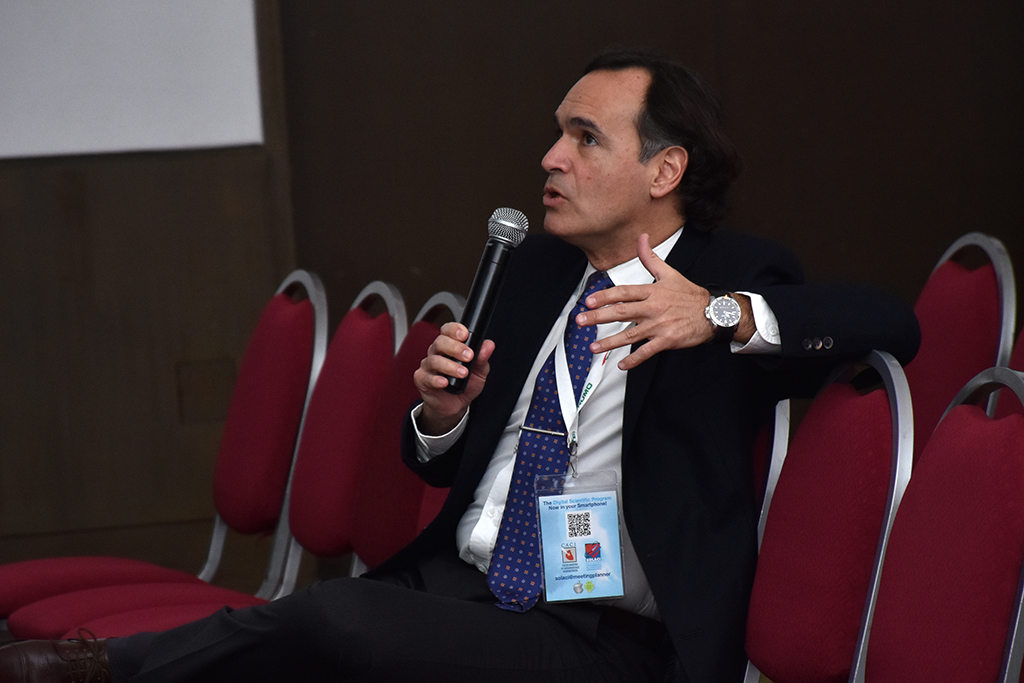
You are the President of SOLACI-CACI 2020, how are you preparing to meet the challenge?
To be the President of SOLACI-CACI 2020, is as much an honor as it is a challenge, which I gladly rise to. Over the years I have had different roles in SOLACI. In fact, I am one of SOLACI founders.
On the other hand, I am about to finish my second year as President of the Argentinian School of Interventional Cardiologists (CACI), and the collaboration between SOLACI and CACI has always been excellent. Indeed, SOLACI’s annual meeting in Buenos Aires have always been very successful. This sets quite high a standard when it comes to pulling in a larger audience, especially in view of how successful the most recent SOLACI meetings have been, namely the last Brazil and Mexico events, with brilliant scientific programs.
The challenge is to outshine these experiences, to contribute to building an outstanding legacy, an agenda more and more ambitious in terms of scientific program and attendance.
You have also been appointed SOLACI Vice-President. What does it mean to you?
To me, to have the trust of SOLACI’s former presidents, as well as the current’s, Dr. José Mangione, represents a great honor. It is an important challenge because I have taken part in this society right from the start, in different roles, and now that SOLACI is growing stronger, I am excited to be able to work with Dr. Mangione.
-What do you mean by growing stronger?
SOLACI has always been strong. When I say stronger, I mean further incorporating our Latin American colleagues. In this sense, in addition to the annual meeting (which is always held in the countries with the largest number of interventional cardiologists: Argentina, Mexico and Brazil) it is essential to support SOLACI Sessions, ProEducar, and to develop an ongoing education scheme. Without question, these will be the greatest challenges of this new board of directors.
Why are SOLACI congresses still necessary?
SOLACI annual meetings aim at showing the reality of global cardiovascular interventionism in Latin America. Not just coronary, structural or valve related, but also in other areas that, depending on the country, have been further developed. For example next year, the meeting in Argentina will revolve around inferior limb disease or aortic disease, which other countries might leave to the endovascular radiologist or the cardiovascular surgeon.
This is how each of SOLACI meetings not only show us where our practice is in Latin America (globally very good), but also what interventionism is like in each of the participating countries. Based on this, SOLACI meetings offer interventionists the chance to extend their practice to territories where it has not been yet developed, offering the benefit of a direct experience. In this sense, we know that today there are many ways to maintain a continuous medical training, but live exchange continues to be enriching beyond compare.
Subscribe to our weekly newsletter
Get the latest scientific articles on interventional cardiology
We are interested in your opinion. Please, leave your comments, thoughts, questions, etc., below. They will be most welcome.



