






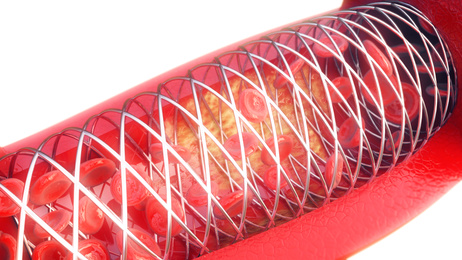
The best strategy to treat in stent restenosis continues to be a dilemma. A new drug eluting stent (DES) seems to be the simplest treatment, even though it adds metal layers that will make it harder and harder to retreat. Drug coated balloons might be a viable alternative seeing as it seems to enable retreatment, even though it has a cost.
Studies comparing these strategies did not have enough statistical power to show significant data. They show heterogenous results.
Because of its relevance, this study was published as “fast track” in the European Heart Journal.
It looked at 10 randomized studies including in total 1033 patients receiving paclitaxel drug coated balloons and 943 receiving DES to treat in-stent restenosis, followed up for 3 years.
Paclitaxel drug coated balloons were associated with a significant increase in target vessel revascularization vs. DES (HR: 1.32, CI 95% 1.02 to 1.7; p=0.035).
Read also: Drug eluting Stents vs. Drug Coated Balloons for In-Stent Restenosis.
There was a significant interaction between treatment effect and restenosis type. For in-stent restenosis of prior DES, the best strategy seems to be a new DES, and for bare metal stent restenosis both a DES and or a drug coated balloon will do the trick.
The combined primary end point of death, MI or target lesion thrombosis resulted comparable between DES and paclitaxel coated balloons (p=0.152) at three years.
Comparing the different DES had also been prespecified in the protocol. Drug coated balloons resulted superior to first generation DES, and similar to the new DES.
Read also: Restenosis Does Not Seem as Benign as We Thought.
Long term mortality, MI and lesion thrombosis resulted comparable, but not new revascularizations, where DES were preferred.
Conclusion
A new PCI with DES seems more effective than PCI with paclitaxel coated balloon to treat in-sent restenosis. Hard points such as death or MI resulted similar, unlike new revascularizations.
Original Title: Paclitaxel-coated balloon angioplasty vs. drug-eluting stenting for the treatment of coronary in-stent restenosis: a comprehensive, collaborative, individual patient data meta-analysis of 10 randomized clinical trials (DAEDALUS study).
Reference: Daniele Giacoppo et al. European Heart Journal (2020) 41, 3715–3728 doi:10.1093/eurheartj/ehz594.
Subscribe to our weekly newsletter
Get the latest scientific articles on interventional cardiology



