






For approximately two decades now, PCI has been the treatment of choice in femoropopliteal territory, and even though technological developments and increasing operator experience have indeed improved outcomes, IVUS (which has showed great benefits in PCI, even reducing left main mortality) is hardly used in this territory.
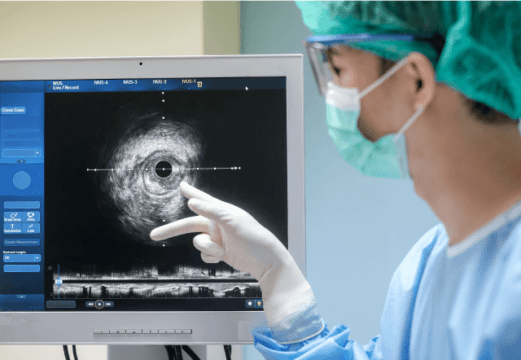
This was a prospective randomized controlled study including 150 patients: 74 angiography guided and 76 IVUS guided.
Primary end point was freedom from binary stenosis guided by IVUS at 12 months (stenosis ≥50% or systolic peak velocity ≥2.4). Secondary end point was TLR because of symptoms, periprocedural complications and MAE (amputation within 30 days, death, MI and stroke) within 12 months after index procedure.
There were no differences between the populations as regards clinical characteristics and risk factors, neither were there differences in angiographic characteristics or strategy (POBA, BARE stents, DES or drug eluting balloons). Diameters and length were also similar, except for the use of drug eluting balloons, which were longer in the IVUS group.
At 12 month follow up, the primary end point resulted in favor of the IVUS group (72.4% vs 55.4%; P= 0.008). There were no differences in freedom from TLR within 12 months after index procedure (84.2% and 82.4%) or in MAE.
Neither were there differences between populations as regards binary restenosis when compared against POBA, BARE stents or DES, but there were differences when using drug eluting balloons in favor of the IVUS group (9.1% vs. 37.5% P= 0.004).
IVUS showed longer lesions and larger vessel diameter compared against angiography guided PCI (diameter 5.60 mm vs. 5.10 mm P<0.001 and length 140 mm vs. 120 mm P=0.01), in addition to nearly 80% of change in strategy.
Conclusion
The use of IVUS showed significant reduction of restenosis rate after endovascular intervention. This is the first study to show IVUS improves evolution in femoropopliteal interventions. This benefit might be related to the use of drug eluting balloons.

Dr. Carlos Fava.
Member of the Editorial Board, SOLACI.org.
Original Title: The Impact of Intravascular Ultrasound on Femoropopliteal Artery Endovascular Interventions A Randomized Controlled Trial.
Reference: Richard B. Allan, et al. J Am Coll Cardiol Intv 2022;15:536–546.
Subscribe to our weekly newsletter
Get the latest scientific articles on interventional cardiology



