






Prosthesis mismatch (PPM) was introduced by Rahimtoola in 1978 and happens when the effective orifice area of a heart valve prosthesis is too small in relation to patient body size. Surgical valves have been well documented, but there is little information on percutaneous valves.
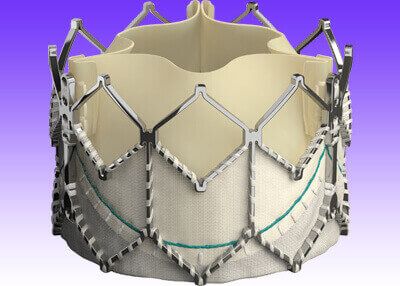
The study looked at 757 patients undergoing TAVR with pre and post procedural eco-Doppler to compare PPM. 420 received the balloon-expandable valve (BEV) SAPIENT THV, XT SAPIEN 3 and 337 the self-expandable (SEV) CoreValve and Evolut R.
PPM was classified at discharge according to effective aortic valve area and body mass index (BMI) into severe (<0.65 cm2/m2) and moderate (0.65 a 0.85 cm2/m2) in the general population. In obese patients (BMI ≥30 Kg/m2) severe PPM was <0.60 cm2/m 2 and moderate PPM was between 0.60 and 0.90 cm2/m2.
Read also: Prosthesis Mismatch in Supra and Intra Annular valves.
Since there were differences between the populations, researchers matched 224 comparable pairs using propensity score.
Pre-dilation was higher in the BEV group, while post-dilation was higher in the SEV group. Valve dislocation or embolization was higher among SEV patients.
At 30 days, there were no differences in events rate, except for higher pacemaker implantation among SEV patients (31.7% vs. 13.8% p<0.001).
Read also: SYMPLICITY Registry: Renal Denervation Continues to Fight Against Oblivion.
The presence of moderate or severe aortic regurgitation was higher among SEV patients (13% vs. 6% p=0.02), but the aortic area (1.80±0.46 vs. 1.68±0.52, p= 0.010) and the effective aortic area indexed to BMI (0.99±0.27 vs. 0.93±0.31, p= 0.021) was significantly higher among SEV patients. On the other hand, the SEV group presented lower gradient vs. the BEV group (8.28±3.87 mmHg vs. 10.68±4.65 mmHg p<0.001).
SEV had lower severe PPM vs. BEV (33.5 vs. 46.9% p=0.003). Patients with small annulus (<430 mm2 area) had higher PPM vs. patients with larger annulus (51.1 vs. 29.3% p<0.003), being numerically more frequent in the BEV group (13.6% vs. 8.6%).
Among patients with larger annulus, severe PPM was also more frequent with BEV (16.9% vs. 5.3%; p=0.004).
Patients with BMI >1.83 cm2 receiving SEV presented lower PPM than patients receiving BEV, but there were no differences in patients with BMI <1.83 cm2.
Read also: Microvascular Angina Could Have Risk Gradients.
Mortality at one year was numerically higher in patients with severe PPM vs. moderate PPM patients and patients with no PPM: there were no differences in functional class at one year.
Conclusion
SEV were associated to lower PPM frequency compared to BEV, regardless annulus area. This difference was observed mainly in patients with >1.83 m2 BMI.
Original Title: Prosthesis-Patient Mismatch Following Transcatheter Aortic Valve Replacement With Supra-Annular and Intra-Annular Prostheses.
Reference: Taishi Okuno, et al. Article in Press.
Get the latest scientific articles on interventional cardiologySubscribe to our weekly newsletter
We are interested in your opinion. Please, leave your comments, thoughts, questions, etc., below. They will be most welcome.



