Watch again our Webinar on Short Dual Therapy in Patients with High Bleeding Risk

Watch again our Webinar on “Short Dual Therapy in Patients with High Bleeding Risk” on our Youtube account. The event was held on 12/08/2020 and had the participation of more than 200 people and the support of ABBOTT.

What things will I learn if I watch this video?

  • 04:02 | Innovation: Short Dual Therapy in Patients with High Risk of Bleeding.
  • 45:12| Interactive Clinical Case with a focus on Antiplatelet Aggregation.
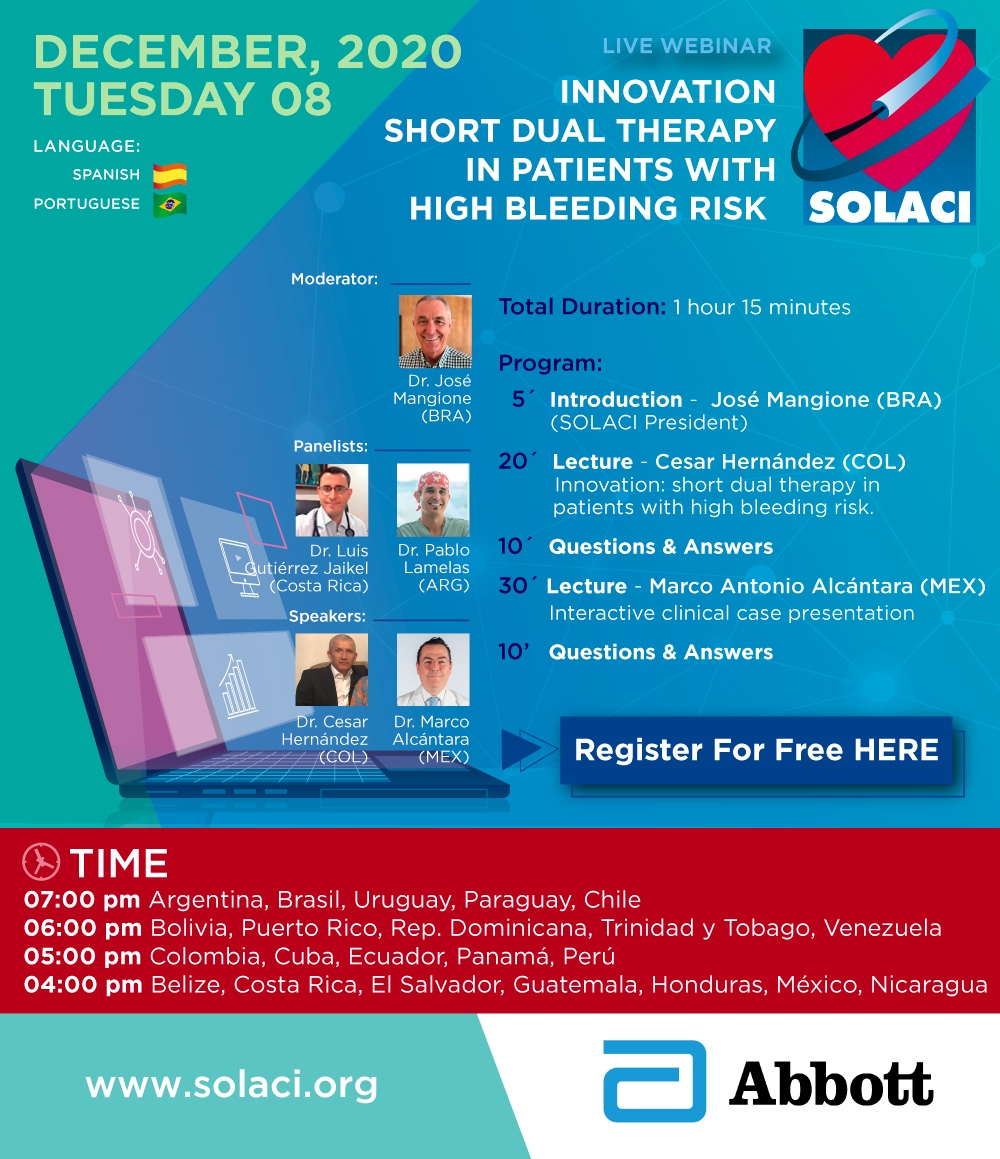
Innovation short dual therapy in patients with high bleeding risk

Subscribe to our weekly newsletter

Get the latest scientific articles on interventional cardiology

More articles by this author

Drugs for the Treatment of No-Reflow During PCI

The no-reflow phenomenon is one of the most frustrating complications of primary angioplasty (pPCI), reflecting persistent microvascular damage that, in the mid- to long-term,...

SOLACI Technicians Webinar – Ultrasound Pulses + Calcium = Coronary Lithotripsy

The Latin American Society of Interventional Cardiology (SOLACI) invites you to participate in a new Live SOLACI Webinar specially designed for technicians, nurses, and...

COMPLICAT 2026: Collaborative learning to address complications in congenital and structural heart disease

Free online course in Spanish5 webinars in 2026 COMPLICAT 2026 returns with its second edition, consolidating itself as an innovative academic space dedicated to the...

CRT 2026 | Clopidogrel vs Aspirin as Long-Term Monotherapy After Coronary Angioplasty

The use of aspirin as chronic antiplatelet therapy after percutaneous coronary intervention (PCI) has historically been the standard recommended by international guidelines. However, recent...

LEAVE A REPLY

Please enter your comment!
Please enter your name here

Related Articles

SOLACI Sessionsspot_img

Recent Articles

Drugs for the Treatment of No-Reflow During PCI

The no-reflow phenomenon is one of the most frustrating complications of primary angioplasty (pPCI), reflecting persistent microvascular damage that, in the mid- to long-term,...

Coronary revascularization before TAVI: prior PCI or conservative management?

The coexistence of coronary artery disease (CAD) in patients with severe aortic stenosis undergoing TAVI is common, with a reported prevalence ranging from 30%...

Rotational atherectomy and its technical secrets: use of floppy or ES guidewire

Rotational atherectomy (RA) remains a very useful tool in the management of severe coronary calcification. However, many of its technical aspects rely more on...