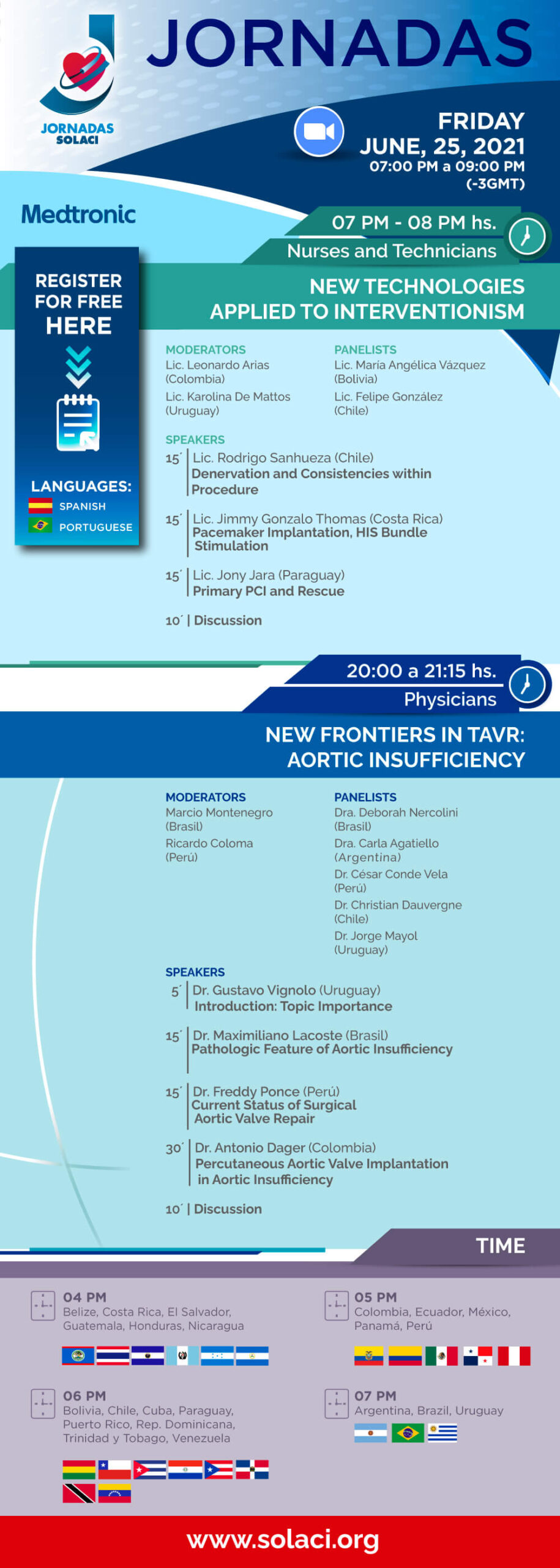
The Latin American Society of Interventional Cardiology (SOLACI) invites you to participate in a new Live SOLACI Webinar specially designed for technicians, nurses, and...
The coexistence of coronary artery disease (CAD) in patients with severe aortic stenosis undergoing TAVI is common, with a reported prevalence ranging from 30%...
Free online course in Spanish5 webinars in 2026
COMPLICAT 2026 returns with its second edition, consolidating itself as an innovative academic space dedicated to the...
The transfemoral approach is the predominant strategy for transcatheter aortic valve implantation (TAVI). Although vascular complications are currently less frequent, they remain relevant determinants...
Atrial fibrillation is associated with an increased risk of stroke and, in patients with contraindications to anticoagulation, percutaneous left atrial appendage closure represents an...
The no-reflow phenomenon is one of the most frustrating complications of primary angioplasty (pPCI), reflecting persistent microvascular damage that, in the mid- to long-term,...
The coexistence of coronary artery disease (CAD) in patients with severe aortic stenosis undergoing TAVI is common, with a reported prevalence ranging from 30%...