






Complex coronary bifurcation PCI, especially in the left main coronary artery (LMCA), represents one of the most technically demanding scenarios in interventional cardiology. Among two-stent strategies, the DK-Crush technique has demonstrated favorable clinical outcomes compared with other techniques, although it requires strict step-by-step standardization. In this context, rewiring of the guidewire into the side branch (SB) is usually performed through the proximal stent struts. However, this recommendation is mainly based on technical considerations and not necessarily on a detailed biomechanical assessment.
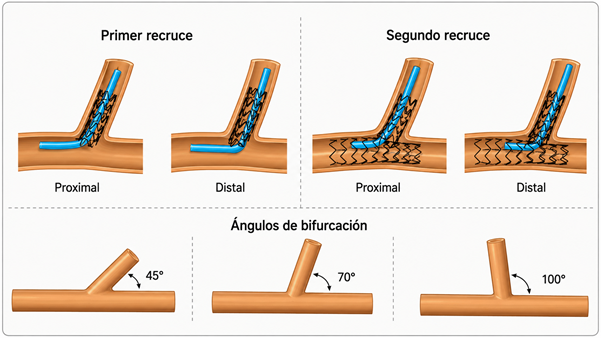
The aim of the study by Colombo et al. was to evaluate, through computational simulation, how bifurcation angle and rewiring configuration interact to influence the mechanical and hemodynamic outcomes of the DK-Crush technique.
Using a computational LMCA bifurcation model with three representative angles (45°, 70°, and 100°), DK-Crush procedures were simulated by combining these three angles with four rewiring configurations: proximal-proximal (P-P), proximal-distal (P-D), distal-proximal (D-P), and distal-distal (D-D). The procedure included the standard steps of the technique: side branch stenting, crush, POT, first kissing balloon inflation (KBI), main vessel stenting, repeat POT, final KBI, and final POT.
The evaluated endpoints included stent malapposition, metal-free area over the SB ostium, and wall shear stress.
Bifurcation angle had a clear impact on the results. Wide bifurcations of 100° showed the worst overall profile, with stent malapposition reaching 18.1%, SB ostial clearance as low as 23%, and greater exposure to elevated wall shear stress. In contrast, angles of 70° and 45° showed more favorable results, although differences were observed depending on the rewiring strategy used.
At a 70° angle, malapposition rates were the lowest in the study, ranging from 12.0% to 14.2%, while the proximal strategies P-P and P-D provided the best balance for SB access. In narrow 45° bifurcations, the hemodynamic profile was the most favorable, with the lowest shear rate values, although the P-D configuration could not be completed due to strut overcrowding after main vessel stent implantation. In this setting, the D-D strategy showed the most balanced performance.
The P-P strategy, usually considered the safest from a technical standpoint, performed well in 45° and 70° bifurcations but showed poor performance in 100° bifurcations due to access obstruction and reduced ostial scaffolding. In this scenario, the D-P configuration provided the most balanced results in wide bifurcations.
Conclusions: Wide LMCA bifurcations showed worse mechanical and hemodynamic behavior with DK-Crush
This study provides a novel mechanistic evaluation of the DK-Crush technique and challenges the concept that a single rewiring strategy is optimal for all anatomies. Wide bifurcations were associated with worse mechanical and hemodynamic performance, whereas intermediate and narrow angles showed more favorable outcomes.
Original Title: Mechanistic Insights Into How Rewiring and Bifurcation Angle Affect DK‐Crush Stent Deployment.
Reference: Colombo A, Carbonaro D, Zhang M, Chiastra C, Webster M, Jepson N, Beier S. Mechanistic Insights Into How Rewiring and Bifurcation Angle Affect DK-Crush Stent Deployment. Catheter Cardiovasc Interv. 2026 Apr;107(5):1314-1323. doi: 10.1002/ccd.70475. Epub 2026 Jan 18. PMID: 41549449; PMCID: PMC13043802.
Subscribe to our weekly newsletter
Get the latest scientific articles on interventional cardiology



, representa uno de los escenarios más exigentes desde el punto de vista técnico.)