






Courtesy of Dr. Rodrigo Abreu.
 INTRODUCTION
Bifurcation lesion treatment has evolved considerably in the last years: from balloon angioplasty (with high occlusion and restenosis rates) to bare metal stent angioplasty (with a procedural success around 86% and major adverse cardiac events [MACE] at 1 year around 32%). The subsequent emergence of drug-eluting stents (DES) reduced considerably the need for repeat revascularization. Despite this improvement, bifurcation lesion angioplasty remains an independent risk factor for stent thrombosis.
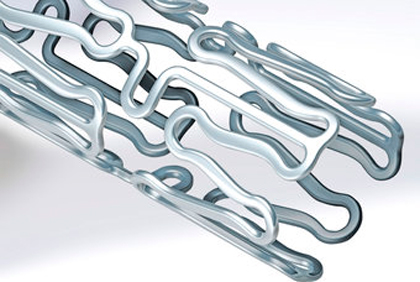
Second-generation DES were developed to reduce flow turbulence and lower thrombosis rates. Such is the case of the Xience V stent (Abbott). The SPIRIT II, SPIRIT III, and SPIRIT IV trials proved the superiority of that stent when compared to paclitaxel-eluting stent Taxus. However, inclusion and exclusion criteria in these trials were too strict, thus preventing the extrapolation of results to real-life patients.
The Xience V USA study proved the safety and efficacy of everolimus-eluting stents (Xience V) in non-selected “real-life” patients with bifurcation lesions.
METHODS
The Xience V USA study was a prospective, multicenter study with 5054 total consecutive patients undergoing angioplasty with everolimus-eluting stents from July, 2008, to December, 2008.
Since the study included all consecutive patients receiving a Xience V stent without any exclusion criteria, it is quite representative of clinical reality.
In such a context, 2 different populations were identified: patients with bifurcation lesions (511) and patients with lesions without bifurcation (4257).
Bifurcation lesions were defined as “any lesion involving the origin of an adjacent side branch.” Any residual lesion <50% (quantitatively or visually) was considered an angiographic success. Follow-up was performed by phone or in person, at 14, 30, and 180 days.
The primary endpoint was probable stent thrombosis at 1 year. The secondary endpoints were a composite of death, infarction, or repeat revascularization.
RESULTS
Patients with bifurcation lesions presented a lower incidence of hypertension:
Hypertension in patients with bifurcation lesions: 82%
Hypertension in patients without bifurcation lesions: 86%
(p = 0.0069)
They also presented a lower diabetes rate:
Diabetes rate in patients with bifurcation lesions: 31.6%
Diabetes rate in patients without bifurcation lesions: 36.1%
(p = 0.0488)
They were most frequently men (73% vs. 68%; p = 0.0263), usually with angina type III-IV according to its functional classification (21.4% vs. 17.1%; p = 0.0224). In these patients, lesions were more calcified (19.6% vs. 13.0%; p = 0.0001) and vessels were more tortuous (9.8% vs. 6.7%; p = 0.0128).
Most bifurcation lesions were located in the anterior descending artery (54.3% vs. 35.7%; p = 0.0001), followed by the circumflex artery (28.0% vs. 23.0%; p = 0.0066), and the trunk of the left coronary artery (3.6% vs. 1.5%; p = 0.0007). Of 511 patients with bifurcation lesions, 24% (127) received treatment in both vessels; a provisional stenting strategy was used on the rest of them.
Compared to the group without bifurcation lesions, the group with bifurcation lesions presented higher subacute stent thrombosis rates (first 30 days) (0.98% vs. 0.38%; p = 0.05), which ceased to be significant after a month (0.61% vs. 0.37%; p = 0.40) and up to a year (late stent thrombosis). Between 1 and 2 years (very late stent thrombosis), the incidence of this complication was very low (0.43% vs. 0.52%; p = 0.90), and no cases were observed at 2 to 4 years of follow-up.
As regards bifurcation lesion types, 44% (225) presented true bifurcation lesions (Medina 1,1,1). This subgroup presented a higher rate of subacute stent thrombosis. However, at 4 years, there were no differences between true bifurcation lesions and the rest (2.03% vs. 2.01%; p = 0.94).
Events at 4 years were similar for both groups (with and without bifurcation lesions), with equal cardiac death, in-hospital Q-wave infarction (0.0% vs. 0.3%; p = 0.38), and non Q-wave infarction (2.8% vs. 1.7%; p = 0.11).
No differences were observed in cardiac death or Q-wave infarction at 30 days either (0.2% vs. 0.4%; p = 0.71). However, there was a higher non Q-wave infarction rate in patients with bifurcation lesions (3.4% vs. 2.0%; p = 0.05).
DISCUSSION
Of 5054 patients, only 10% presented bifurcation lesions. Of them, 50% presented true bifurcation lesions (Medina 1,1,1), but only 25% received treatment for both vessels. A provisional stenting strategy was used on the remaining 75%, since that is the most appropriate alternative according to current evidence.
Moreover, bifurcation lesion treatment with a systematic 2-stent technique was associated with more in-hospital events and events at 9 months, with higher rates of peri-procedural infarction, x-ray doses and procedural duration, thus matching the recommendation of using a provisional stenting technique whenever possible.
Bifurcation lesion treatment, regardless of the technique used, is associated with higher enzyme levels (non Q-wave infarction), higher subacute stent thrombosis rates, and higher revascularization of treated vessels. In an analysis according to subgroup, patients with true bifurcation lesions were associated with higher subacute thrombosis rates. This is unsurprising, since lesion complexity is higher for this patient group.
Despite a higher incidence of non Q-wave infarction in the group with bifurcation lesions, this was not associated with worse time course data (compared to the group without bifurcation lesions), since long-term outcomes were similar for both groups.
LIMITATIONS
Given the low number of patients with bifurcation lesions and the low number of events, this study lacks statistical power for the detection of differences in stent thrombosis.
CONCLUSIONS
The Xience V USA study analyzed non-selected patients undergoing angioplasty with an everolimus-eluting stent in the United States. In this context, bifurcation lesions accounted for about 10% of all cases, and 50% of these were true bifurcation lesions. Up to 75% of these patients were treated using a provisional stenting technique. The evolution of patients treated with other techniques was comparatively worse, thus supporting the idea that the aforementioned strategy is the most appropriate course of action for these lesions.
Patients with bifurcation lesions presented a higher incidence of non Q-wave infarction at baseline, which was not associated with worse long-term evolution (which was similar to that of the group without bifurcation lesions).
Although patients with bifurcation lesions proved to present higher rates of subacute stent thrombosis, the statistical power of this study as regards the detection of this complication is limited.
Courtesy of Dr. Rodrigo Abreu. American Cardiology Center, Montevideo American Hospital, Uruguay.
Original title: Clinical Outcomes in Real-World Patients With Bifurcation Lesions Receiving Xience V.Everolimus-Eluting Stents: Four-Year Results from the Xience V USA Study
Reference: James B. Hermiller et al. Catheter Cardiovasc Interv. 2016 Jul;88(1):62-70.
We are interested in your opinion. Please, leave your comments, thoughts, questions, etc., below. They will be most welcome.



