






This study, presented by Dr. Valentin Fuster, focused on the importance of medical treatment compliance, initially showing data from the FOCUS study where the poor compliance observed in patients after an acute myocardial infarction (AMI) event was improved by creating a polypill (aspirin, simvastatin, and ramipril).
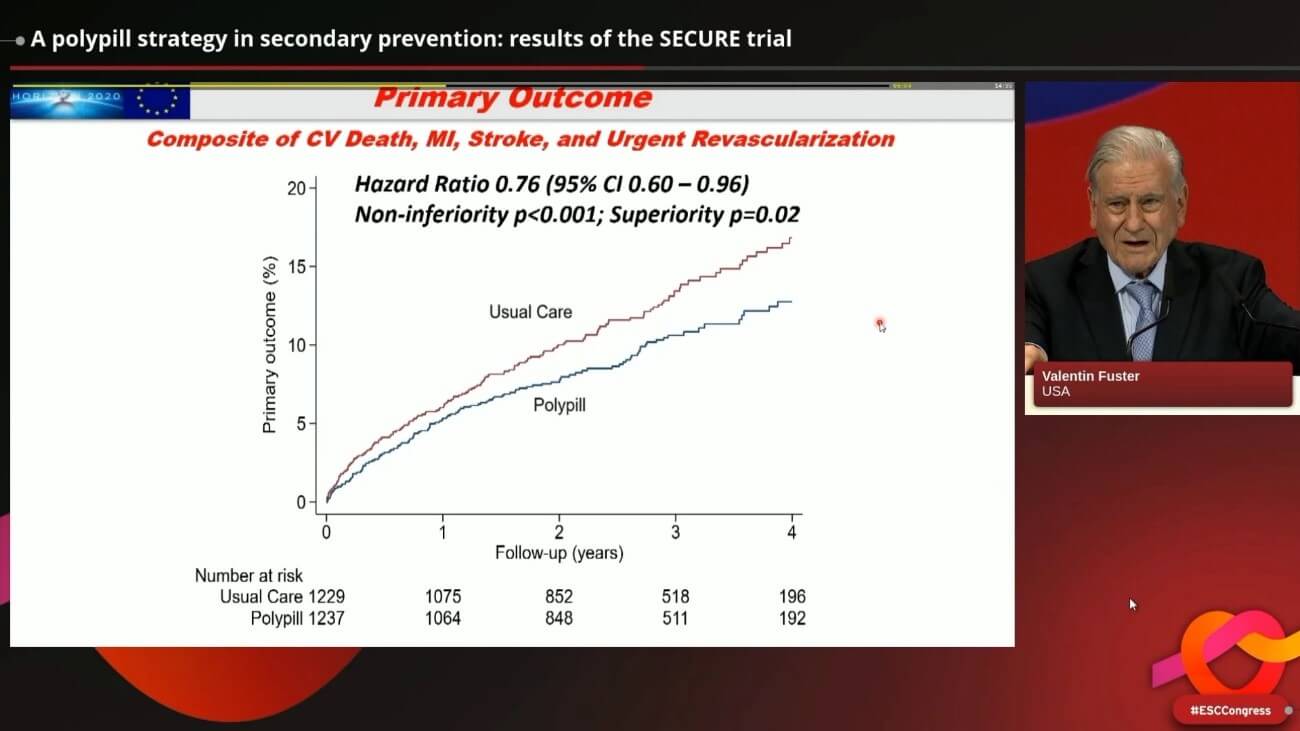
Based on this, the SECURE randomized study was conducted in elderly patients with prior AMI within 6 months of randomization. These patients had at least one of the following characteristics: documented diabetes mellitus, mild to moderate renal disease, prior AMI, prior revascularization, prior stroke, or age over 75 years old. The mean follow-up was 3 years.
A polypill (aspirin 100 mg, atorvastatin 20/40 mg, and ramipril 2.5/5/10 mg) was administered in the treatment arm while the control arm received the standard of care. The primary endpoint (PEP) was a composite of cardiovascular death, AMI, stroke, or emergency revascularization. The secondary endpoint (SEP) was a composite of cardiovascular death, AMI, or stroke.
A total of 2499 patients were randomized after infarction, with a mean age of 76 years old; 69% of patients were male, 42% had diabetes, and 77% were hypertensive.
There was a 24-% decrease in the PEP (hazard ratio [HR]: 0.76, 95% confidence interval [CI]: 0.60-0.96; pnoninferiority < 0.001 and psuperiority = 0.02), driven by a reduction in cardiovascular death. In terms of the SEP, there was a significant difference of 30% (HR: 0.70, 95% CI: 0.54-0.90; p = 0.005). This benefit was observed in the prespecified groups. In turn, there were no differences in adverse effects.
Read also: TAVR in Bicuspid Patients: Are Outcomes the Same in Men and Women?
Dr. Fuster concluded that treatment with a polypill could be an integral part of future treatment for the prevention of cardiovascular events in patients who had an AMI.
Dr. Omar Tupayachi.
Member of the Editorial Board of SOLACI.org.
Font: Fuster V. Polypill reduces cardiovascular events in heart attack patients compared to usual care (SECURE Trial). Presentado en el Congreso Europeo de Cardiología ESC 2022. Agosto 26, 2022. Barcelona, España.
Subscribe to our weekly newsletter
Get the latest scientific articles on interventional cardiology



