






Transcatheter mitral valve replacement (TMVR) represents one of the most complex areas within structural interventions. Unlike TAVI, where valvular anatomy typically provides more predictable anchoring, the mitral valve presents challenges such as a more dynamic annulus, greater anatomical variability, risk of left ventricular outflow tract (LVOT) obstruction, and anatomies not suitable for edge-to-edge repair (M-TEER).
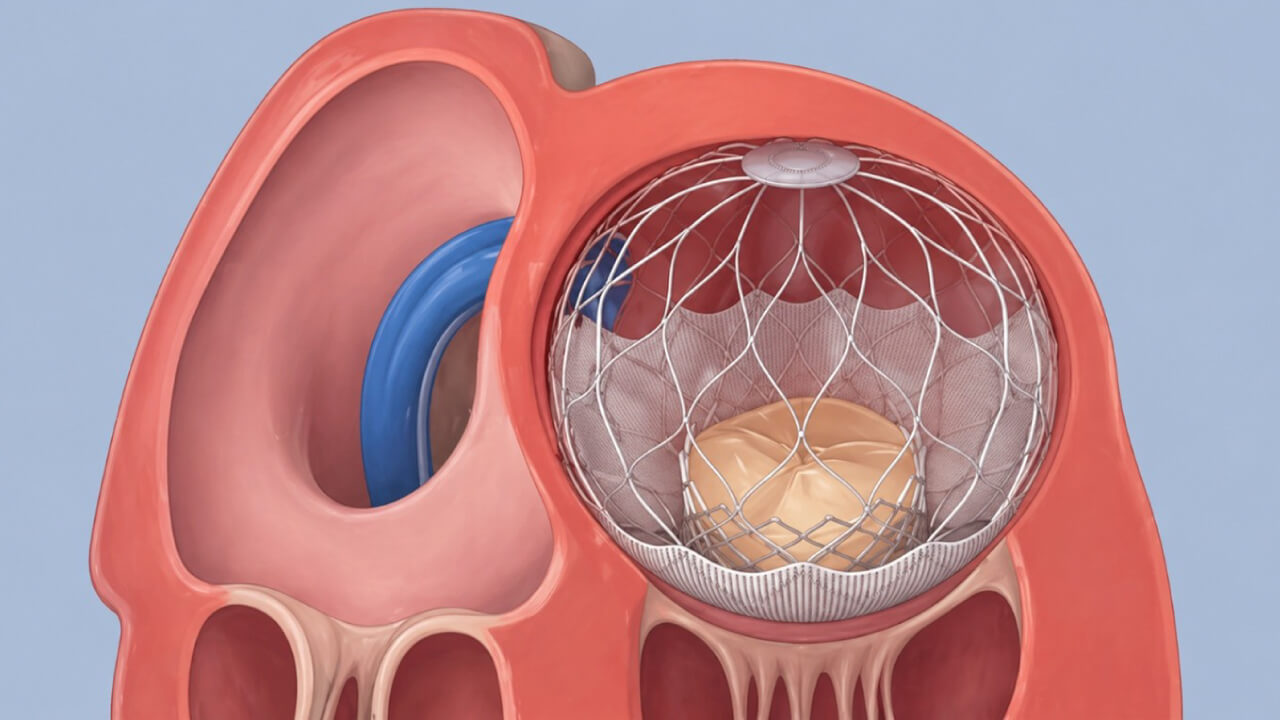
In this context, the AltaValve Early Feasibility Study evaluated a TMVR strategy with atrial fixation, designed to treat patients with significant mitral regurgitation (MR) who are not candidates for surgery or M-TEER repair. The AltaValve system was developed to address a broad patient population, including those at risk of LVOT obstruction, with large mitral annuli, or mitral annular calcification.
This was a prospective, multicenter, single-arm study that included 30 patients with symptomatic MR ≥3+. MR etiology was degenerative in 43%, functional in 50%, and mixed in 7%. The mean age was 77 years, 63% were women, and 80% were in NYHA functional class III/IV. The access route was transapical in 13 patients and transseptal in 17.
The AltaValve system is a supra-annular valve with atrial fixation, designed to reduce the risk of LVOT obstruction and minimize stress on surrounding structures.
One-year results show a favorable trend in both hemodynamic and clinical efficacy. Technical success and MR reduction were achieved in 97% of cases. At one-year follow-up, MR reduction to ≤1+ and NYHA functional class I/II were maintained in 95% of patients. The mean mitral gradient was 4.0 mmHg and the LVOT gradient was 1.8 mmHg.
From a functional standpoint, patients demonstrated improvement in the 6-minute walk test distance, with an average increase of 43 meters. Regarding safety, one patient developed HALT and thrombosis associated with poor adherence to medical therapy. No cases of stroke, device embolization, new-onset atrial fibrillation, life-threatening bleeding, or need for pacemaker implantation were reported.
Conclusions: One-year outcomes of the AltaValve device in symptomatic severe mitral regurgitation
The AltaValve Early Feasibility Study suggests that atrial fixation TMVR may expand the therapeutic landscape for patients with symptomatic severe MR, high surgical risk, and anatomies unsuitable for other transcatheter strategies.
Original Title: AltaValve Early Feasibility Study: One-Year Outcomes with Atrial Fixation Transcatheter Mitral Valve Replacement.
Presented by: Konstantinos Voudris en el SCAI 2026 Scientific Sessions & CAIC-ACCI Summit, Montreal, Canadá.
Subscribe to our weekly newsletter
Get the latest scientific articles on interventional cardiology



