






Original Title: Bioresorbable Everolimus-Eluting Vascular Scaffold for Patients With Peripheral Artery Disease (ESPRIT I) 2-Year Clinical and Imaging Results CME.
Reference: Johannes Lammer et al. J Am Coll Cardiol Intv. 2016;9(11):1178-1187.
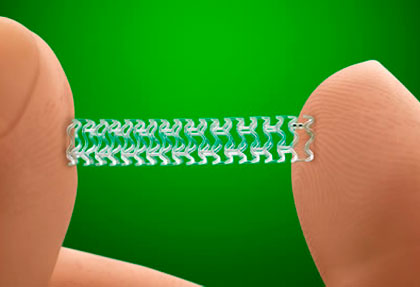 This is the first study on humans to assess the bioresorbable everolimus eluting vascular scaffold for the treatment of peripheral artery disease involving the external iliac and superficial femoral arteries.
After the success of new bioresorbable scaffolds in coronary territory, it was only a matter of time before they tested this new technology in peripheral territory.
The ESPRIT BVS is an everolimus-eluting poly-l-lactide scaffold and it was tested for the first time in 35 patients with intermittent claudication.
88.6% of treated lesions were in the superficial femoral artery and 11.4% in the external iliac artery. Lesion mean length was 35.7 ± 16.0 mm and devices were successfully deployed in all patients, without recoil.
Three patients presented minor complications such as puncture site hematoma or post implantation dissection.
At one year, binary restenosis resulted in 12.1%. At two years, 16.1%. Not all patients required revascularization:
At one year: 8.8%.
At two years: 11.8%.
The ankle brachial index improved from 0.75 ± 0.14 at baseline to 0.96 ± 0.16 at two years.
At 2 years, 71% of patients were in Rutherford class 0, and 93.5% of the population had achieved maximum walking distance of 500 m.
Conclusion
Safety of the bioresorbable everolimus eluting scaffold was shown, with a low rate of revascularization consistent with duplex-ultrasonography showing sustained patency at two years.
Editorial Comment
Treated lesions, as in most of first-in-man studies that test new devices, were short and with no total occlusions. Severely calcified lesions are frequent in femoropopliteal territory and are a real challenge for this new devices.
We value your opinion. You are more than welcome to leave your comments, thoughts, questions or any ideas here below.



