






Courtesy of Dr. Carlos Fava.
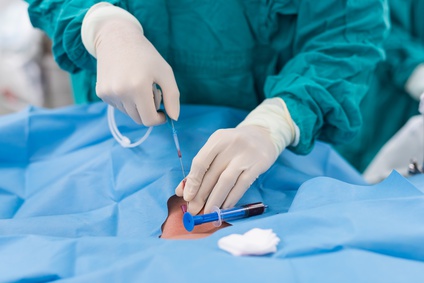 Transfemoral access is the first choice for transcatheter aortic valve replacement (TAVR). However, this approach is not feasible for a progressively larger number of patients, which establishes the need to search for alternative accesses.
Between 2009 and 2014, this study enrolled 174 patients who underwent TAVR and were unsuitable for transfemoral TAVR. Transcarotid access was used as an alternative. For 122 patients the procedure was carried out under general anesthesia, and 52 patients received a minimally invasive procedure under local anesthesia and sedation.
Populations were similar; the mean age was 80.5 years old and the STS predicted risk of mortality score was 8.4%. Patients receiving a minimally invasive strategy presented higher rates of coronary disease and prior revascularization surgery. General anesthesia was used more frequently during the first years of this trial.
Transcarotid access was successful for all patients. The valve most frequently used was CoreValve (78.9%), followed by SAPIENS XT (16.6%), and Lotus (1.1%).
There were no major vascular complications; 18.9% of patients required a permanent pacemaker, and new atrial fibrillation was present in 8.6% of them regardless of the type of anesthesia used on them.
There were no differences in all-cause death and cardiac death at 30 days and at a year concerning the type of anesthesia used (7.3% vs. 7.6%, and 13.9% vs. 9.6%, general anesthesia vs. local anesthesia, respectively).
At 30 days, the efficacy endpoint was 85.2% for general anesthesia vs. 94.2% for local anesthesia (p = 0.09), and the safety endpoint was 77.8% vs. 86.5%, respectively (p = ns).
There were 10 cerebrovascular events (5.7%) in the general anesthesia group: 4 strokes (2.2%) and 6 transient ischemic attacks (3.4%). There were no cerebrovascular events in the minimally invasive strategy group (p <0.001).
There were no differences in valve performance as assessed through echocardiography.
Conclusion
Transcarotid access for transcatheter aortic valve replacement is feasible using both general and local anesthesia. Patients who received general anesthesia presented higher rates of peri-procedural stroke.
Editorial
This series, with a large number of patients, shows that transcarotid access is a viable alternative when transfemoral access is unfeasible.
The higher rates of cerebrovascular events may have been related to the learning curve, since general anesthesia was used more frequently at the beginning of the series. However, it should be noted that not all patients are suitable for a minimally invasive strategy.
The determination of the best access once the transfemoral approach is unfeasible requires further research.
Courtesy of Dr. Carlos Fava. Buenos Aires Favaloro Foundation, Argentina.
Original title: Transcarotid Transcatheter Aortic Valve Replacement. General or Local Anesthesia.
Reference: Nicolas Debry et al. J Am Coll Cardiol Intv 2016;9:2113-20.
Subscribe to our weekly newsletter
Get the latest scientific articles on interventional cardiology
We are interested in your opinion. Please, leave your comments, thoughts, questions, etc., below. They will be most welcome.



