






Transradial access is here to stay; that much has been clear for some time now. However, some operators still resist change and the systematic use of this technique shows great geographical dispersion. Some of its limitations are a difficulty to obtain access and the somewhat frequent occurrence of radial artery occlusion after the procedure. This study assessed a very simple resource to avoid artery occlusion: an injection of nitroglycerin at the puncture site.
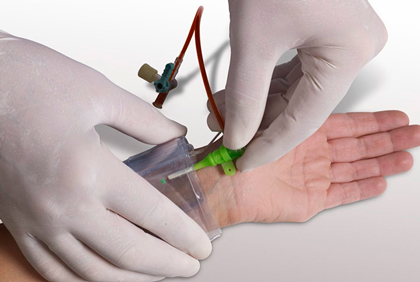 This work included 188 patients undergoing transradial catheterization who were randomized to subcutaneous injection of 0.5 mL 0.1% nitroglycerin at the puncture site or a placebo. All patients were assessed through ultrasound examinations before and at 24 hours after the procedure.
Upon comparison of the radial artery diameter before and after the procedure, patients in the nitroglycerin-treated group presented a significantly greater diameter than patients in the placebo control group. Most importantly, the incidence of occlusion was substantially lower in the nitroglycerin-treated group (5.4% vs. 14.4%; p = 0.04).
Read also: Antiaggregation Time after Treating Bifurcations.
There were no significant differences in other complications (forearm hematoma, pseudoaneurysm, etc.).
Conclusion
Subcutaneous injection of nitroglycerin at the radial artery puncture site increases the radial artery diameter and reduces the incidence of radial artery occlusion post-catheterization.
Original title: Subcutaneous Injection of Nitroglycerin at the Radial Artery Puncture Site Reduces the Risk of Early Radial Artery Occlusion After Transradial Coronary Catheterization. A Randomized, Placebo-Controlled Clinical Trial.
Reference: Yequn Chen et al. Circ Cardiovasc Interv. 2018;11:e006571.
Get the latest scientific articles on interventional cardiologySubscribe to our weekly newsletter
We are interested in your opinion. Please, leave your comments, thoughts, questions, etc., below. They will be most welcome.



