


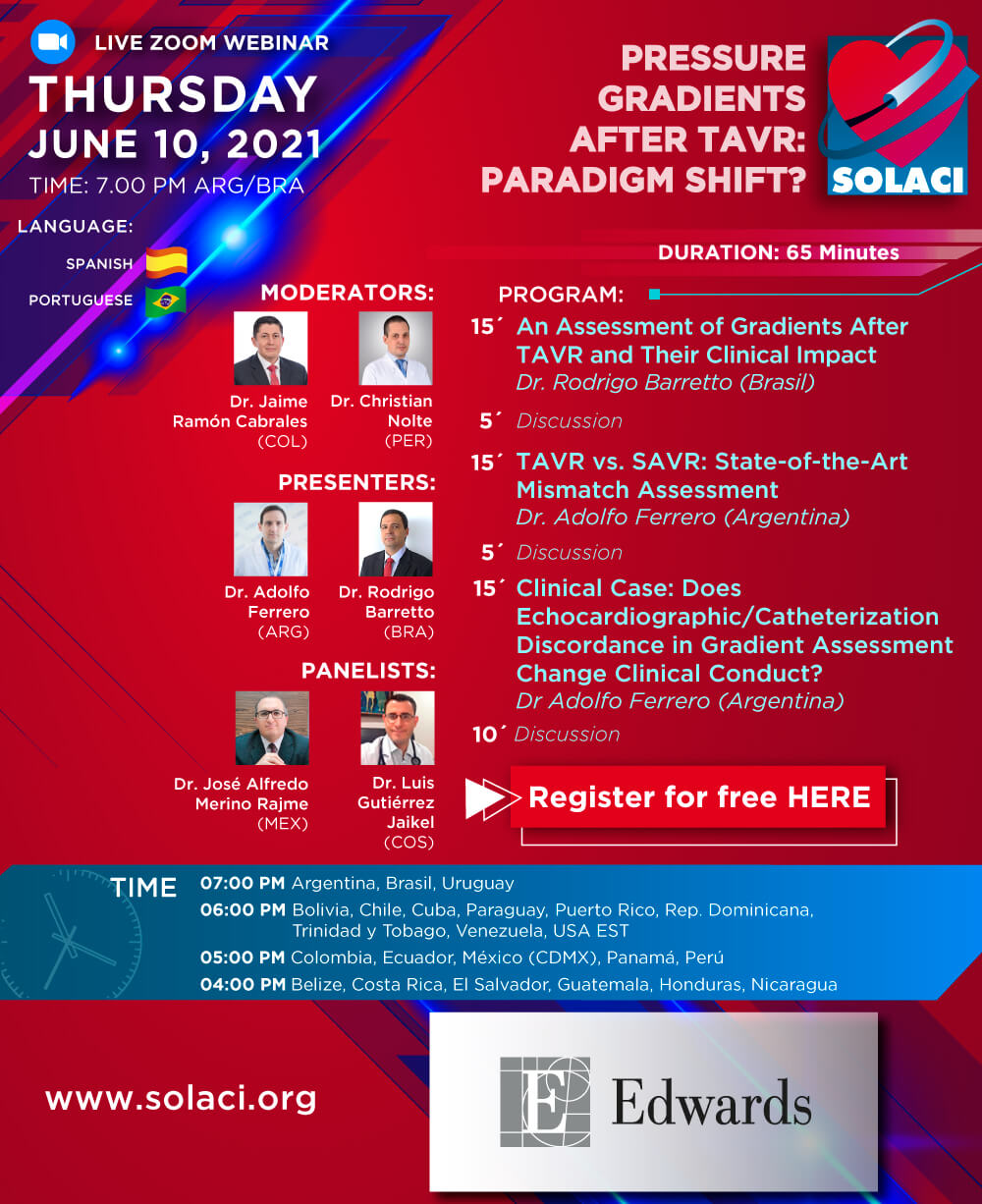
06/10 | SOLACI Webinar – Pressure Gradients After TAVR: Paradigm Shift?


Subscribe to our weekly newsletter

Get the latest scientific articles on interventional cardiology

More articles by this author

VECTOR: First Percutaneous Aorto-Coronary Bypass Case, a New Conceptual Approach

Coronary obstruction represents one of the most severe complications associated with transcatheter aortic valve implantation, particularly in valve-in-valve scenarios involving surgical bioprostheses, narrow aortic...

Advanced Postgraduate Course in Hemodynamics and Interventional Cardiology – 2026 Edition

Registration is now open for the SOLACI–CACI Advanced Postgraduate Course in Hemodynamics and Interventional Cardiology – 2026 Edition. The program is intended for physicians with...

Is it safe to use negative chronotropic drugs early after TAVI?

TAVI is associated with a relevant incidence of conduction system disturbances and the development of atrioventricular block that may require permanent pacemaker implantation. Many...

Transapical TMVR in High Risk Patients: Intrepid 5-Year Outcomes

Moderate to severe mitral valve regurgitation (MR) continues is still a high prevalence condition with bad prognosis, particularly among the elderly with left ventricular...

LEAVE A REPLY

Please enter your comment!
Please enter your name here

Related Articles

SOLACI Sessionsspot_img

Recent Articles

VECTOR: First Percutaneous Aorto-Coronary Bypass Case, a New Conceptual Approach

Coronary obstruction represents one of the most severe complications associated with transcatheter aortic valve implantation, particularly in valve-in-valve scenarios involving surgical bioprostheses, narrow aortic...

Comparison of strategies: NMA of IVUS, OCT, or angiography in complex lesions

Percutaneous coronary intervention (PCI) in complex lesions continues to represent a technical challenge in contemporary interventional cardiology. Angiography, although it remains the most widely...

Is upper-limb aerobic training an effective alternative to lower-limb exercise in peripheral artery disease?

Peripheral artery disease is associated with impaired functional capacity, reduced walking distance, and poorer quality of life, and structured exercise is a class I...



