The Best of the SOLACI-SOCIME 2022 Main Arena: Structural—Selected Topics of TAVR

On the last session from day 1 of SOLACI-SOCIME 2022 on structural pathology, Dr. Raj Makkar, an international expert on the subject, talked about transcatheter aortic valve replacement (TAVR) in pure aortic regurgitation (AR), which presents several implantation challenges, such as insufficient anchoring, embolization, residual regurgitation, ring rupture, etc. 

As opposed to patients with aortic stenosis, patients with AR had a higher migration index, more transcatheter reintervention, and greater surgical reintervention.

Additionally, only 25% of patients with severe AR are treated in the US, which shows us that this is an undertreated population. While using devices developed for aortic stenosis is accepted, they are off-label for AR, as they are not ideal for its anatomy, which opens up an opportunity to test specific devices.
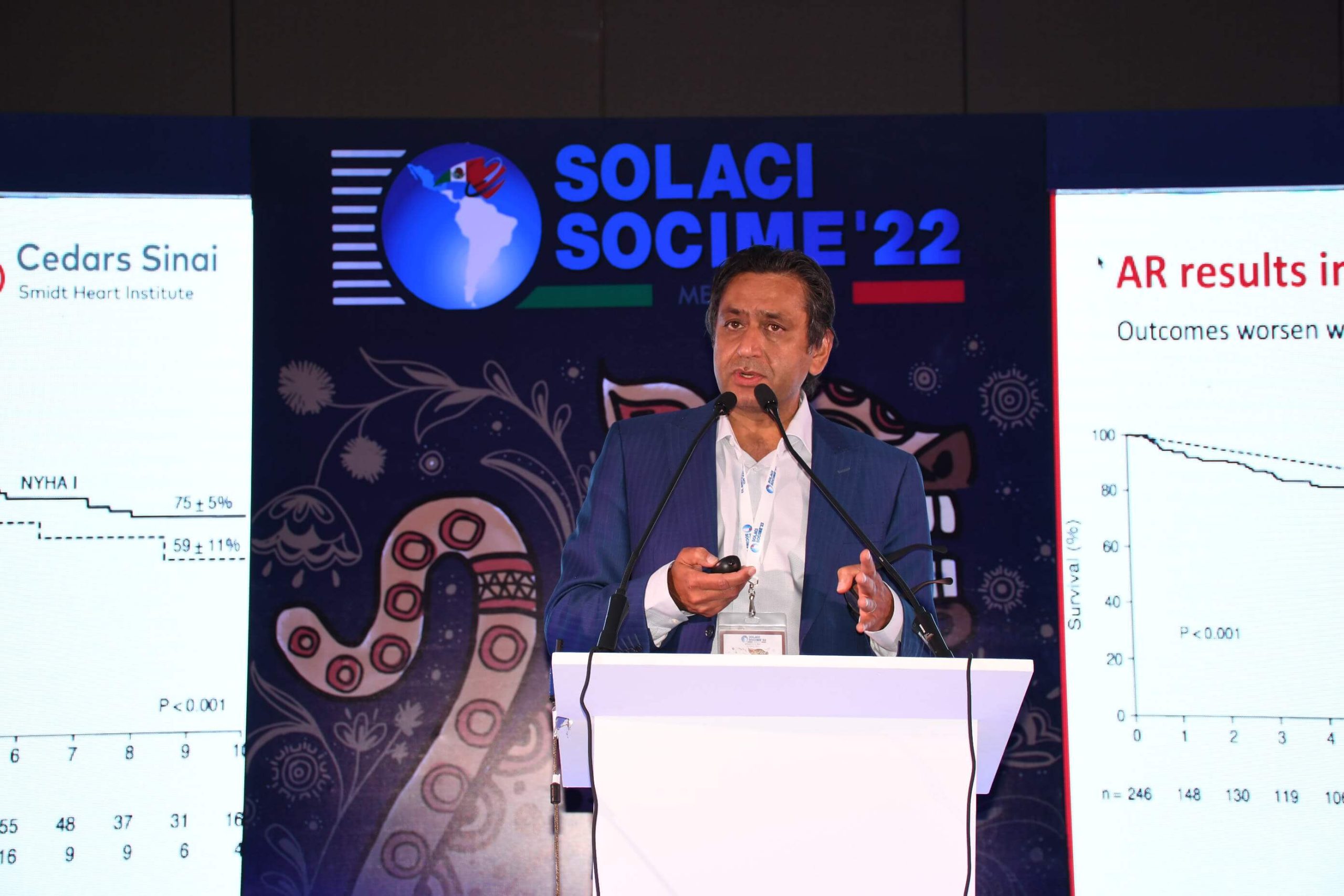
Dr. Raj Makkar (USA)

Later, Dr. Ole De Backer (DEN) addressed the clinical implications of imaging findings, such as reduced leaflet motion or their hypoattenuation (HALT).

Through tomographic studies with adequate follow-up, these issues might not impact transvalvular gradient, thromboembolic events, or mortality. The only affected parameter was eventual long term durability (hypothesis).

He discouraged the systematic search for this problem; it should only be suspected in patients with a mean gradient >10 mmHg, early degeneration, or a neurological event unrelated to another cause.

Dr. Ole de Backer (DNK)
Dr. Omar Tupayachi

Dr. Omar Tupayachi.
Member of the Editorial Board of SOLACI.org.


Subscribe to our weekly newsletter

Get the latest scientific articles on interventional cardiology

More articles by this author

Is it really necessary to monitor all patients after TAVR?

Conduction disorders (CD) after transcatheter aortic valve replacement (TAVR) are a frequent complication and may lead to the need for permanent pacemaker implantation (PPI)....

Is it really necessary to monitor all patients after TAVR?

Conduction disorders (CD) after transcatheter aortic valve replacement (TAVR) are a frequent complication and may lead to the need for permanent pacemaker implantation (PPI)....

Transradial Aortic Valvuloplasty: Is Minimalism Worth It?

Balloon aortic valvuloplasty (BAV) has historically been used either as a bridge strategy, an assessment tool, or even palliative treatment in severe aortic stenosis...

Atrial Fibrillation After Percutaneous Patent Foramen Ovale Closure: Cohort Study with Continuous Implantable Cardiac Monitoring

Atrial fibrillation (AF) is a recognized complication following percutaneous closure of a patent foramen ovale (PFO), with reported incidences of up to 30% during...

LEAVE A REPLY

Please enter your comment!
Please enter your name here

Related Articles

SOLACI Sessionsspot_img

Recent Articles

Coronary Perforations and Use of Covered Stents: Safe and Effective Long-Term Strategy?

Coronary perforations remain one of the most serious complications of percutaneous coronary intervention (PCI), especially in cases of Ellis ruptures type III. In these...

Is it really necessary to monitor all patients after TAVR?

Conduction disorders (CD) after transcatheter aortic valve replacement (TAVR) are a frequent complication and may lead to the need for permanent pacemaker implantation (PPI)....

Is it really necessary to monitor all patients after TAVR?

Conduction disorders (CD) after transcatheter aortic valve replacement (TAVR) are a frequent complication and may lead to the need for permanent pacemaker implantation (PPI)....