The Best of the SOLACI-SOCIME 2022 Main Arena: Structural—Selected Topics of TAVR

On the last session from day 1 of SOLACI-SOCIME 2022 on structural pathology, Dr. Raj Makkar, an international expert on the subject, talked about transcatheter aortic valve replacement (TAVR) in pure aortic regurgitation (AR), which presents several implantation challenges, such as insufficient anchoring, embolization, residual regurgitation, ring rupture, etc. 

As opposed to patients with aortic stenosis, patients with AR had a higher migration index, more transcatheter reintervention, and greater surgical reintervention.

Additionally, only 25% of patients with severe AR are treated in the US, which shows us that this is an undertreated population. While using devices developed for aortic stenosis is accepted, they are off-label for AR, as they are not ideal for its anatomy, which opens up an opportunity to test specific devices.
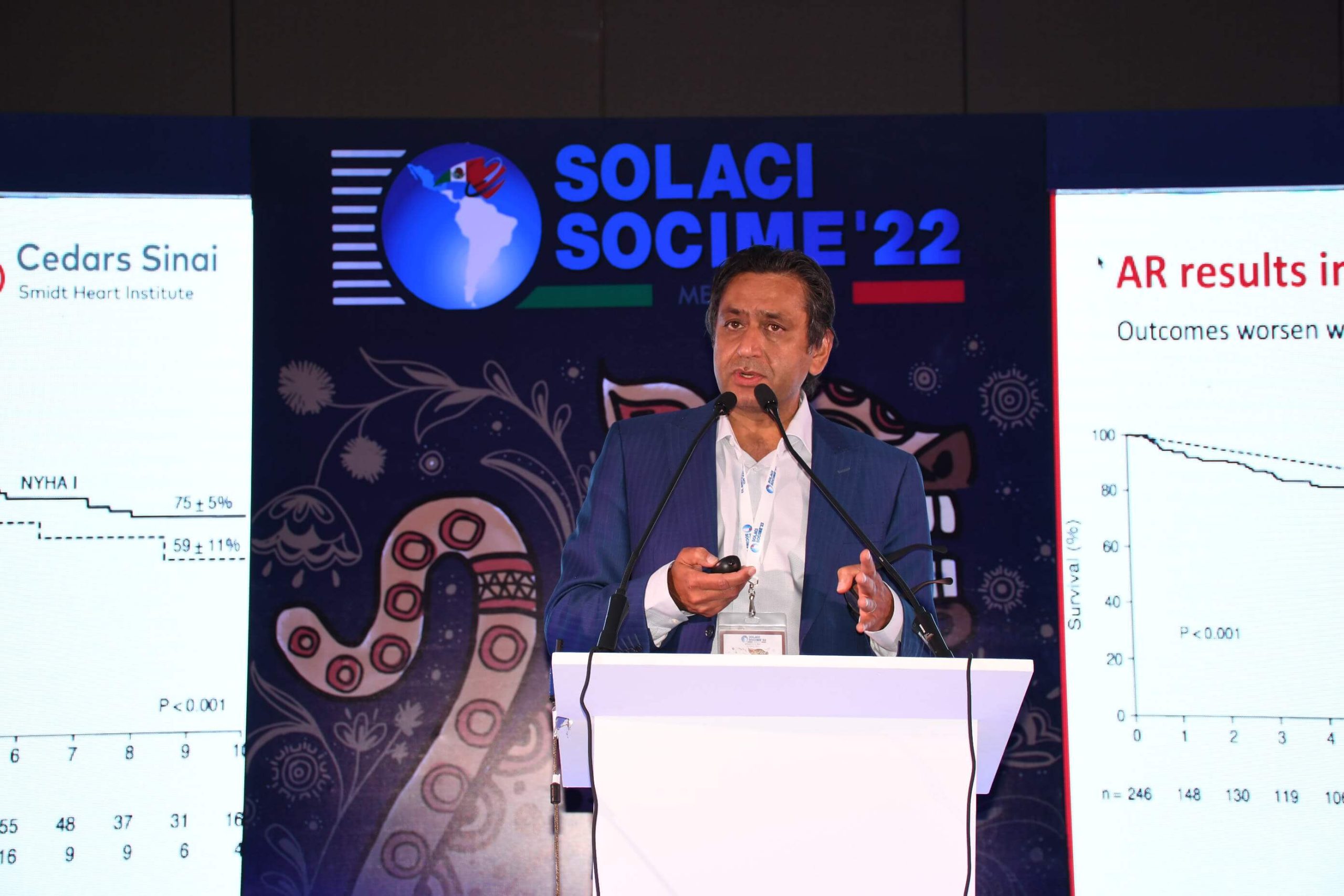
Dr. Raj Makkar (USA)

Later, Dr. Ole De Backer (DEN) addressed the clinical implications of imaging findings, such as reduced leaflet motion or their hypoattenuation (HALT).

Through tomographic studies with adequate follow-up, these issues might not impact transvalvular gradient, thromboembolic events, or mortality. The only affected parameter was eventual long term durability (hypothesis).

He discouraged the systematic search for this problem; it should only be suspected in patients with a mean gradient >10 mmHg, early degeneration, or a neurological event unrelated to another cause.

Dr. Ole de Backer (DNK)
Dr. Omar Tupayachi

Dr. Omar Tupayachi.
Member of the Editorial Board of SOLACI.org.


Subscribe to our weekly newsletter

Get the latest scientific articles on interventional cardiology

More articles by this author

Experience with the intra-annular self-expanding Navitor valve: data from the STS/ACC TVT registry

The expansion of TAVI, with the introduction of new-generation devices, has prioritized not only periprocedural safety, but also the preservation of coronary access, more...

The Two Sides of the Coin: What Do CHAMPION-AF and CLOSURE-AF Teach Us About Left Atrial Appendage Closure?

Letter to the editor: Juan Manuel Pérez Asorey Percutaneous left atrial appendage closure (LAAO) is currently going through one of the most interesting stages of...

CLOSURE-AF: Percutaneous Left Atrial Appendage Closure versus Medical Therapy in Atrial Fibrillation

Percutaneous left atrial appendage closure has been proposed as an alternative to anticoagulation in patients with atrial fibrillation and high bleeding risk; however, comparative...

CLOSURE-AF: Percutaneous Left Atrial Appendage Closure versus Medical Therapy in Atrial Fibrillation

Percutaneous left atrial appendage closure has been proposed as an alternative to anticoagulation in patients with atrial fibrillation and high bleeding risk; however, comparative...

LEAVE A REPLY

Please enter your comment!
Please enter your name here

Related Articles

SOLACI Sessionsspot_img

Recent Articles

Experience with the intra-annular self-expanding Navitor valve: data from the STS/ACC TVT registry

The expansion of TAVI, with the introduction of new-generation devices, has prioritized not only periprocedural safety, but also the preservation of coronary access, more...

Therapeutic strategies in carotid free-floating thrombus: evidence and controversies

Carotid free-floating thrombus (cFFT) is a rare entity with a high embolic risk, associated with acute neurological events such as stroke or transient ischemic...

The Two Sides of the Coin: What Do CHAMPION-AF and CLOSURE-AF Teach Us About Left Atrial Appendage Closure?

Letter to the editor: Juan Manuel Pérez Asorey Percutaneous left atrial appendage closure (LAAO) is currently going through one of the most interesting stages of...