



IVUS in Every Step of Complex Angioplasty

Complex angioplasties require not only experience and patience but also technology. Imaging–guided pre-dilation, stent sizing, and post-dilation reduced the cardiovascular events after a 3-year follow-up in patients who received drug-eluting stents in complex angioplasties.
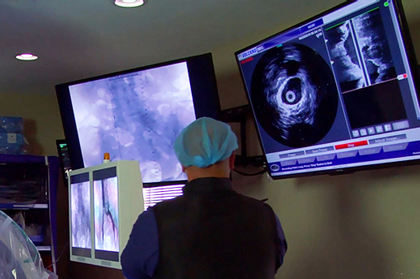
El uso del ultrasonido intravascular en la angioplastia de tronco no protegido se asocia con mejores resultados en comparación con la angioplastia guiada solo por angiografía.

This paper, recently published in JACC Interventions, compared the 3-year outcome of the complex angioplasty optimization technique with intravascular imaging to “customize” every step of the procedure.

Researchers evaluated 9,525 patients from the IRIS-DES (Interventional Cardiology Research In-cooperation Society-Drug-Eluting Stents) registry who underwent angioplasty in the left main coronary artery, bifurcation lesions, long or diffuse (>30mm) lesions, or severe calcification. Intravascular ultrasound (IVUS) was used in 89.5% of patients (n = 8522).

IVUS was conducted in every step of the procedure (pre-dilation, stent sizing, and post-dilation) for just over a third of patients (35.4%) This subgroup was defined as the optimized complex angioplasty arm.


Read also: IVUS in Unprotected LMCA Angioplasty: Should We Change the Way We Use It?


After 3 years of follow-up, those who underwent optimized angioplasty had a significantly lower risk of suffering adverse events (5.6% vs. 7.9%; hazard ratio [HR]: 0.71; 95% confidence interval [CI]: 0.63 to 0.81; p < 0.001).

This difference was significant, even when IVUS was used in the rest of the population in at least one step of the procedure.

These results confirm data from the ULTIMATE and the IVUS-XPL.

Conclusion

Patients who undergo complex coronary angioplasty where IVUS is performed in every step of the procedure experience fewer adverse events after 3-years of follow-up. All-step optimization should be actively applied in routine practice.

Original Title: Optimal Stenting Technique for Complex Coronary Lesions. Intracoronary Imaging-Guided Pre-Dilation, Stent Sizing, and Post-Dilation.

Reference: Hanbit Park et al. J Am Coll Cardiol Intv 2020;13:1403–13. https://doi.org/10.1016/j.jcin.2020.03.023.


Subscribe to our weekly newsletter

Get the latest scientific articles on interventional cardiology

We are interested in your opinion. Please, leave your comments, thoughts, questions, etc., below. They will be most welcome.


More articles by this author

AHA 2025 | OCEAN Study: Anticoagulation vs. Antiplatelet Therapy After Successful Atrial Fibrillation Ablation

After a successful atrial fibrillation (AF) ablation, the need to maintain long-term anticoagulation (AC) remains uncertain, especially considering the very low residual embolic risk...

AHA 2025 | VESALIUS-CV: Evolocumab in High-Cardiovascular-Risk Patients Without Prior MI or Stroke

LDL cholesterol is a well-established factor for cardiovascular disease. Therapy with PCSK9 inhibitors, including evolocumab, has been shown to reduce the risk of cardiovascular...

AHA 2025 | TUXEDO-2: Post-PCI Antiplatelet Management in Diabetic Patients with Multivessel Disease — Ticagrelor or Prasugrel?

Choosing the optimal P2Y12 inhibitor for diabetic patients with multivessel coronary artery disease undergoing percutaneous coronary intervention (PCI) remains a major clinical challenge. These...

AHA 2025 | DECAF: Coffee Consumption vs. Abstinence in Patients with Atrial Fibrillation: Recurrence or Myth?

The link between coffee consumption and arrhythmia has been met with contradicting recommendations. It is widely believed that caffeine could trigger atrial fibrillation (AF)...

LEAVE A REPLY

Please enter your comment!
Please enter your name here

Related Articles

SOLACI Sessionsspot_img

Recent Articles

Atrial Fibrillation After Percutaneous Patent Foramen Ovale Closure: Cohort Study with Continuous Implantable Cardiac Monitoring

Atrial fibrillation (AF) is a recognized complication following percutaneous closure of a patent foramen ovale (PFO), with reported incidences of up to 30% during...

Impact of Baseline Systolic Blood Pressure on Blood Pressure Changes Following Renal Denervation

Renal denervation (RDN) is a guideline-recommended therapy to reduce blood pressure in patients with uncontrolled hypertension, although uncertainties remain regarding which factors best predict...

AHA 2025 | OPTIMA-AF: 1 Month vs. 12 Months of Dual Therapy (DOAC + P2Y12) After PCI in Atrial Fibrillation

Concomitant atrial fibrillation (AF) and coronary artery disease is a common occurrence in clinical practice. In these patients, current guidelines recommend 1 month of...
