






Courtesy of Dr. Carlos Fava.
In the last decades, there has been a marked increase in the use bioprosthetic valves in aortic position given their benefits over mechanical valves. However, long term follow-up has shown structural valve degeneration (SVD). Given the risk of a second surgery after TAVR, valve-in-valve (ViV) has been on the rise, and we are yet to determine its long-term evolution.
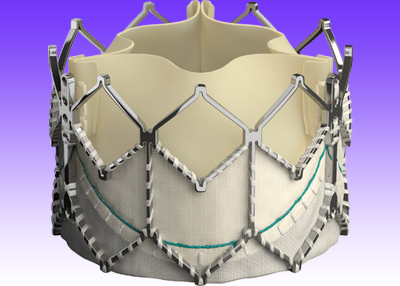
The VIVID registry, including 1006 patients between 2007 and 2014 was analyzed.
The percutaneous valves used were: 52% Medtronic (CoreValve/Evolut), 43,2% Edward Sapien (SAPIEN/SAPIEN XT/SAPIEN3) and 4,8% other valves.
Mean age was 77, 59% were men, 27.3% were diabetic, 22.3% had peripheral vascular disease, 54.5% had chronic kidney deterioration, most were in functional class III/IV, STS was 7.3% and most presented stented bioprosthesis.
SVD was most frequently caused by stenosis in addition to moderate to severe regurgitation, with mean gradient 35.5± 17.5 mmHg.
Patients with a small annulus (<20 mm) were older, presented severe prosthesis mismatch and more stented bioprosthetic valves.
Read also: Valve in Valve Presents Better Evolution than re-SARV.
Estimated survival at 8 years was 38%, with mean 6.2 years, shorter for patients presenting small annuli (33.2% vs. 40.5% p=0.01). In multivariable analyzis, small annuli, age, low ejection fraction, kidney failure and non-femoral access were associated to mortality.
Freedom from reintervention at 8 years was 93.2% and it was required in 39 patients. 16 of these patients received new TAVR and 23, SAVR. There were no differences in mortality at 30 days. Reintervention predictors were age, prosthesis mismatch and malapposition. Balloon expandable valves required intervention more often (2% vs. 6% p=0.02).
Conclusion
Bioprosthesis structural failure might affect mortality and type of valve. It might affect reintervention need.
Courtesy of Dr. Carlos Fava.
Original Title: Long-term outcomes after transcatheter aortic valve implantation in failed bioprosthetic valves.
Reference: Sabine Bleiziffer, et al. European Heart Journal (2020) doi:10.1093/eurheartj/ehaa544.
Get the latest scientific articles on interventional cardiologySubscribe to our weekly newsletter
We are interested in your opinion. Please, leave your comments, thoughts, questions, etc., below. They will be most welcome.



