






Original Title: Long-Term Results of Everolimus-Eluting Stents versus Drug-Eluting Balloons in Patients with Bare-Metal In-Stent Restenosis 3-Year Follow-Up of the RIBS V Clinical Trial.
Reference: Alfonso F. et al. JACC Cardiovasc Interv. 2016 Jun 27;9(12):1246-55.
Courtesy of Dr. Agustín Vecchia.
RIBS V 3 year follow up
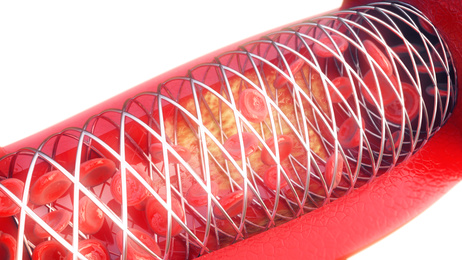 Stents have become the gold standard for nearly all transcatheter percutaneous coronary interventions. However, at present, restenosis treatments with these scaffolds is under heated debate.
The aim of this study was to compare long term efficacy of everolimus eluting stents (EES) vs. drug eluting balloons (DEB) in patients with instent restenosis of Bare-Metal Stents (BMS).
189 patients with BMS instent restenosis were randomized to EES (n=94) or DEB (n=95). Follow up was carried out at 0ne, two and three years on 100% patients. Patients treated with EES had better angiographic results than those treated with DEB (larger minimal luminal diameter at follow up, primary study end point: 2.36 ± 0.6 mm vs. 2.01 0.6 mm; p < 0.001).
At three years, both groups had similar:
Cardiovascular mortality:
EES: 2%
DEB: 1%
AMI rate:
EES: 4%
DEB: 5%
Target vessel revascularization rate:
EES: 9%
DEB: 5%
It is worth noting that target lesion revascularization rate (TLR) was significantly lower in the EES arm (2% vs. 8%; p=0.04; HR: 0.23; 95% CI: 0.06 to 0.93).
The need for late revascularization (beyond 1 year) target vessel (3 [3.2%] vs. 3 [3.2%]; p=0.95) and target lesion (1 [1%] vs. 2 [2.1%]; p=0.54) were low and similar in both groups.
Definite or probable thrombosis rate (1% vs. 0%) was low and similar in both groups.
Conclusion
The authors conclude that this study confirms the long term safety and efficacy of both treatments and that everolimus eluting stents reduce the need for new revascularizations in the long run.
Editorial Comment
In prior comparative studies between DEB and first generation DES (PEPCAD II, ISAR-DESIRE 3, PEPCAD China) DEB efficacy had already been proved in the treatment of instent restenosis. Siontis et all1 have recently published in Lancet a meta-analyzis of all available treatments (27 studies, 5923 patients) showing both strategies are safe and effective and that EES have showed better outcomes, though direct comparison between EES and DEB had not shown significant differences. At one year follow up, the present study had published a larger minimal luminal diameter by angiography at one year2.
In this study, Alfonso et all bring new data to show these differences. Mainly, they found that during the first year, TLR is significantly lower in the EES arm, with no change in AMI, mortality or TVR. As from the first year, both treatments had similar results.
In conclusion, both strategies are safe and effective to manage BMS instent restenosis and despite the low number of events, EES seems to be associated to a lower rate of TLR during the first year of follow up, which maintains at 3 years.
Some of the theoretical advantages of DEB are a lower DAPT without adding a second layer of metal. There is still much to clarify when it comes to instent restenosis, picking a strategy is challenging and should be done on a case by case basis. Finally, and still under discussion, bioresorbable scaffolds may have a role in the treatment of ISR:
1: Percutaneous coronary interventional strategies for treatment of in-stent restenosis: a network meta-analysis George C M Siontis, Giulio G Stefanini, Dimitris Mavridis, Konstantinos C Siontis, Fernando Alfonso, María J Pérez-Vizcayno, Robert A Byrne, Adnan Kastrati, Bernhard Meier, Georgia Salanti, Peter Jüni, Stephan Windecker Lancet 2015; 386: 655–64
2: A Randomized Comparison of Drug-Eluting Balloon Versus Everolimus-Eluting Stent in Patients With Bare-Metal Stent–In-Stent Restenosis The RIBS V Clinical Trial (Restenosis Intra-stent of Bare Metal Stents: Paclitaxel-eluting Balloon vs. Everolimus-eluting Stent). Journal of the American College of Cardiology Vol. 63, No. 14, 2014
Courtesy of Dr. Agustín Vecchia. German Hospital, Buenos Aires, Argentina.
Your opinion matters to us. You are most welcome to leave your comment, reflection, question or any ideas down below.



